
Blogs
The law is dynamic and constantly evolving – and so is Rothwell Figg. We are at the forefront of the legal developments that impact businesses and industries, and our blogs provide communications that are relevant to client goals and objectives across local, regional, national, and global markets.

PTAB Law Blog
-

Key Takeaways
- The Patent Trial and Appeal Board (PTAB) has reaffirmed its earlier priority determination in favor of the Broad Institute in the long-running interference dispute regarding the use of CRISPR-Cas9 in eukaryotic cells.
- The decision remains significant because it was issued after remand from the U.S. Court of Appeals for the Federal Circuit, which had directed the PTAB to reassess its legal analysis under a clarified conception standard.
- Despite this heightened scrutiny, the PTAB again found that the CVC group failed to establish prior conception of a working CRISPR-Cas9 system in eukaryotic cells. The ruling reinforces the principle that, because of the inherent unpredictability in biotechnology, how reduction to practice was accomplished takes on greater significance than in more predictable arts.
- The decision has important implications for gene-editing technologies, biologics development, and the evolving relationship between platform patents and downstream therapeutic innovation.
Background
The CRISPR dispute concerns the invention of CRISPR-Cas9 for use in eukaryotic cells, including plant, animal, and human cells. The competing parties include the Broad Institute and the CVC group, which consists of the University of California, Berkeley, the University of Vienna, and key scientific figures such as Feng Zhang, Jennifer Doudna and Emmanuelle Charpentier.
While the CVC group was instrumental in developing CRISPR-Cas9 in bacterial systems, the legal dispute centers on whether they also conceived and reduced to practice its successful use in eukaryotic cells. This distinction is critical because eukaryotic applications are necessary for therapeutic and commercial use in humans.
Because the patents and applications at issue were either filed under or claim benefit to applications that were filed under the pre-America Invents Act framework, the case is governed by a first-to-invent interference proceeding. In the first stage of an interference, a determination is made as to which party filed the earlier application containing a conception and constructive reduction to practice of the invention. The second stage of an interference requires analysis of both conception and reduction to practice. Determining when conception has occurred in this second stage is always retrospective. The first decision is what constitutes either a constructive or actual reduction to practice. Only then can a determination be made as to when conception occurred. The first to reduce to practice prevails in an interference unless the second to reduce to practice can prove they had a prior conception and were diligent from prior to the conception of the first to reduce to practice until their own actual or constructive reduction to practice.
The following flowchart summarizes the key CRISPR interference proceedings and related patent disputes, illustrating how the Broad-CVC, ToolGen, and Sigma-Aldrich matters developed in parallel across PTAB proceedings, Federal Circuit review, and commercial implementation-related patent issues.
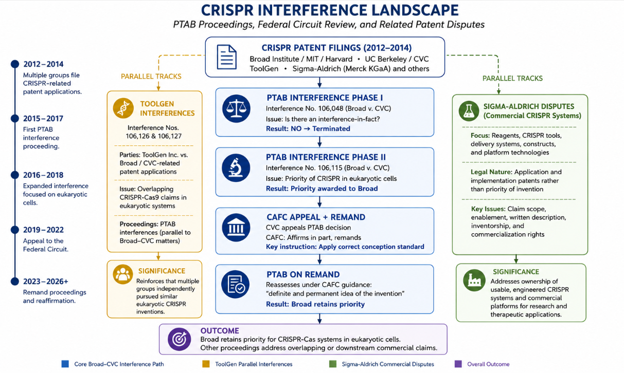
Our coverage of the first CRISPR interference decision was discussed in an earlier blog post: PTAB Sides with Broad in Patent Dispute over CRISPR Gene Editing of Eukaryotic Cells | RF EMerge
The PTAB’s March 2026 Decision
The PTAB found the evidence presented by CVC reflected ongoing research efforts rather than a completed inventive concept. In contrast, the Broad Institute provided evidence demonstrating successful reduction to practice of CRISPR-Cas9 in eukaryotic systems.
On March 26, 2026, the PTAB issued a judgment in the CRISPR-Cas9 Interference reaffirming priority in favor of the Broad Institute. The Board reached this conclusion after reconsidering the case on remand from the Federal Circuit. The appellate court had instructed the PTAB to apply a proper conception standard – specifically, whether the inventors had a “definite and permanent idea of the complete and operative invention” such that a person of ordinary skill could reduce it to practice without extensive experimentation. Applying that standard the Board again determined the CVC group did not establish a sufficiently definite and permanent idea of the invention in eukaryotic cells11. In the decision remanding to the Board, the Federal Circuit had affirmed the determination of the Board that CVC was not entitled to the benefit of its first two patent applications because they did not evidence conception of the invention and thus Broad had filed the earliest application with a conception of the invention. That meant that CVC had to provide evidence that it was the first to conceive the invention.
In determining CVC did not have a conception, the Board emphasized that adapting CRISPR-Cas9 from prokaryotic to eukaryotic cells was not a routine or predictable step. Instead, it involved significant technical uncertainty relating to cellular compatibility, guide RNA functionality, and nuclear delivery mechanisms.
As a result, the PTAB concluded that CVC did not have a conception prior to the actual reduction to practice by the Broad Institute and thus awarded priority to the Broad Institute.
Where Things Stand Next
The CVC- Broad CRISPR interference dispute will continue since CVC filed a Notice of Appeal at the Federal Circuit on May 26th. Future proceedings may continue to refine the legal standards governing conception and reduction to practice, particularly in unpredictable technological fields.
The parallel interference proceedings remain unresolved and warrant close monitoring as the ongoing legal disputes continue to develop, and their outcomes will be important in shaping the overall CRISPR-Cas9 patent landscape. In particular, the continuing involvement of ToolGen and Sigma-Aldrich highlights the broader reach of the interference framework beyond the central CVC-Broad dispute.
What the Decision Means for Biotech Innovation
This decision reinforces an important principle in patent law: in unpredictable scientific fields such as gene editing, an inventor must demonstrate more than a conceptual idea. The invention must be sufficiently developed to show that a person of ordinary skill could reduce it to practice without extensive experimentation or that it is actually operable in the relevant biological context.
The ruling also underscores the importance of experimental validation, particularly where the underlying science involves substantial uncertainty. Even where legal priority frameworks differ, the ability to demonstrate a functioning system remains central to how patentability is assessed in complex life sciences technologies. It is preferable to include actual experiments in the application because attempting to prove a person of ordinary skill could have reduced it to practice without extensive experimentation is always difficult.
More broadly, the decision arises within a large shift in biotechnology toward platform technologies. Because CRISPR-Cas9 functions not as a single product but a foundational tool, the patent determinations in this space will have cascading effects across the entire innovation ecosystem including downstream applications such as gene therapy, cell engineering, and advanced biologics development.
Further Considerations for Practitioners
The PTAB’s decision offers several important lessons for patent practitioners and life sciences companies.
- Patent applications in biotechnology should be supported by detailed experimental evidence that demonstrates operability in relevant systems. Conceptual disclosures alone may not be sufficient to establish description and enablement constituting conception of an invention.
- Under the America Invents Act (AIA), which took effect on March 16, 2013, the United States operates under a first-to-file system, which replaced the former first-to-invent framework. In practice, this means that the effective filing date of a patent application is usually determinative of priority, rather than the date of actual invention. Delays in filing can result in loss of rights even where conception occurred earlier.
- For platform technologies, early clarity on ownership and scope can significantly affect licensing leverage, freedom-to-operate, and downstream partnering opportunities.
Conclusion
The PTAB’s March 2026 decision reaffirming the Broad Institute’s priority in CRISPR-Cas9 is more than a procedural reaffirmation. It reflects a broader principle in patent law, namely that invention in unpredictable scientific fields requires demonstrated functionality rather than theoretical possibility. That evidentiary standard, when applied to foundational CRISPR-Cas9 technologies, contributes to prolonged and fragmented disputes over patent rights across the eukaryotic space. Organizations developing or commercializing CRISPR-based technologies should closely monitor these legal proceedings, as their outcomes may materially affect broader strategic planning in the genome-editing space including freedom-to-operate positions and licensing frameworks.
Looking Ahead
We will continue to monitor further developments at the PTAB and Federal Circuit regarding CRISPR-Cas9 and related patent proceedings, and provide insight and updates as they become available.
Disclaimer: The information contained in this posting does not, and is not intended to, constitute legal advice or express any opinion to be relied upon legally, for investment purposes or otherwise. If you would like to obtain legal advice relating to the subject matter addressed in this posting, please consult with us or your attorney. The information in this post is also based upon publicly available information, presents opinions, and does not represent in any way whatsoever the opinions or official positions of the entities or individuals referenced herein.
R. Danny Huntington provided advice regarding interferences to the Broad Institute during proceedings prior to the remand.
- Regents of the University of California v. Broad Institute, Inc., Interference No. 106,115, Paper 2915 (PTAB March 26, 2026). ↩︎
-

Following up on our 2024 Trial Statistics Trends at the PTAB, this blog post expands on the statistics and trends at the PTAB for the Fiscal Year 2025 (“FY25”), which runs from October 1, 2024 through September 30, 2025.
Petitions Filed
In FY25, 1,433 petitions were filed, which was 145 petitions more than the petitions filed in FY24.[1] Out of the 1,433 petitions filed, 95% were for inter partes review (“IPR”) and 5% were for post grant review (“PGR”).[2] In comparison to FY24, the percentage of petitions filed in each technology remained consistent. Specifically, 67% of petitions were electrical/computer (compared to 69% in FY24), 20% mechanical or business methods (compared to 22% in FY24), 7% bio or pharma (compared to 6% in FY24), 6% chemical (compared to 3% in FY24), and less than 0.5% design (compared to less than 1% in FY24).[3] Accordingly, in terms of the number and technology fields for petitions filed, FY25 was consistent with prior fiscal years at the PTAB.[4]
Institution Rates
Unlike the consistency with the petitions filed, FY25 revealed significant differences in the institution rate trends. As a result of the changes described in the numerous memoranda issued by the PTAB over the past year, the PTAB split the disposition rates into Director Discretionary Considerations (“DSCO”) and Board Disposition Decisions.[5] For DSCO, the director denied institution for 304 petitions (60%) and referred 201 petitions (40%) to the Board.[6] Thus, out of 935 total petitions, the Board granted institution for 66% (620 petitions) and denied institution for 34% (315 petitions).[7] In combination, this resulted in an institution rate of 50% for FY25 based on the 620 petitions that were granted institution and the 619 petitions that were denied institution either by the Director or the Board.[8]
Outcomes
In FY25, 1,470 petitions reached an outcome at the PTAB between October 1, 2024 and September 30, 2025. Out of the total petitions, approximately 26% (387 petitions) reached final written decisions. Out of those that reached final written decisions, 17% (250 petitions) held all claims unpatentable, 4% (62 petitions) held all claims patentable, and 5% (75 petitions) held some claims patentable and some claims unpatentable. Additionally, 44% (644 petitions) were denied institution either by the Board or DSCO. For the remaining petitions, 25% (368 petitions) settled, 2% (36 petitions) requested adverse judgment, and 2% (35 petitions) were dismissed.[9]
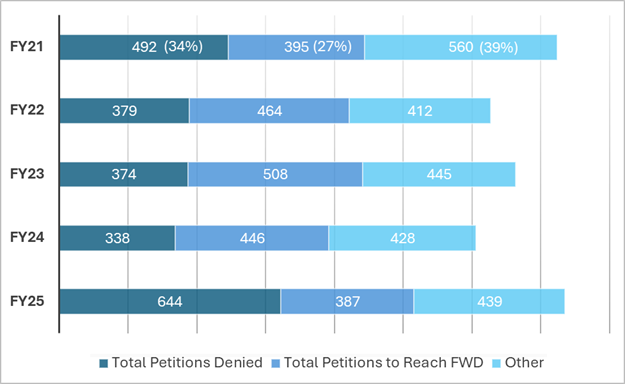
Source: The data for this chart can be found at https://www.uspto.gov/patents/ptab/statistics
As shown by the chart above, the percentage of petitions denied institution in FY25 increased by at least 10% over the last five years, while the percentage of petitions to reach final written decisions decreased by at least 10%. Notably, the number of petitions to request adverse judgment, settle, or be dismissed remained relatively consistent, which indicates that this category of outcomes did not impact the institution rate.
Conclusion
The FY25 PTAB trends, specifically regarding the decrease in institution rates, reflect the changes that patent practitioners have monitored throughout the past year. As changes to the framework for discretionary denials continue, it is likely that institution rates will continue to decrease even more significantly than the 10% decrease reflected in FY25. Thus, it remains of important for PTAB practitioners to continue to monitor PTAB guidance and statistical trends to provide the best representation for their clients by considering alternative strategies and assessing risk.
More information about the PTAB’s trial statistics for FY25 and previous years may be found at: https://www.uspto.gov/patents/ptab/statistics.
[1] See PTAB Trial Statistics FY25 End of Year Outcome Roundup IPR, PGR, USPTO, 3 https://www.uspto.gov/sites/default/files/documents/Trial_StatsFY25_Q4.pdf (last visited Dec. 20, 2024); see also PTAB Trial Statistics FY24 End of Year Outcome Roundup IPR, PGR, USPTO, 3 https://www.uspto.gov/sites/default/files/documents/ptab_aia_fy2024__roundup.pdf (last visited Dec. 20, 2024)
[2] See PTAB Trial Statistics FY25 at 3.
[3] See id.
[4] See https://www.ptablaw.com/2025/01/06/trial-statistics-trends-at-the-ptab-2024-edition/
[5] See PTAB Trial Statistics FY25 at 6.
[6] See id.
[7] See id.
[8] See id. at 7.
[9] See id. at 11.
-

The first half of 2025 has brought many changes at the United States Patent and Trademark Office (“USPTO”), including policy changes at the Patent Trial and Appeal Board (“PTAB”). At the end of March 2025, the issuance of the Interim Procedure for Discretionary Denials in AIA Post-Grant Proceedings with Parallel District Court Litigation memorandum (the “Interim Procedure”) and the Interim Processes for PTAB Workload Management memorandum (the “Workload Management”) initiated changes to discretionary denials for inter partes review (IPR) and post grant review (PGR) proceedings.[1] At the time, patent practitioners were unsure of the Workload Management’s exact impact. However, nearly six months later, we can now begin to analyze the resulting trends to understand the impact of the recent changes at the PTAB.
IPR & PGR Institution Rates
At this early stage, it appears that patent practitioners were accurate when they predicted that the number of discretionary denials would increase, resulting in a decrease in the number of institutions.

From FY22 to FY25 Q2, the institution rate for IPRs and PGRs increased from 66% to 68%.[2] Beginning in April 2025, after the issuance of the memoranda, the institution rate began to decrease. FY25 through April showed an institution rate by petition of 65%.[3] The institution rate decreased again according to the statistics for FY25 through May, which showed an institution rate of 63%.[4] Notably, the 63% institution rate by petition as of May 2025 is lower than the institution rate was in FY22, FY23, and FY24. Thus, in only a few months, the institution rate for IPRs and PGRs has decreased at a faster rate than by which it increased from FY22 to FY24.
Conclusion
Although it is too early to make conclusive predictions, the current institution rate trends show that the institution rate for IPRs and PGRs is decreasing at a rapid rate. The shift from a steadily increasing institution rate over the last few years to a sudden downward turn strongly suggests that the policy changes favor patent owners at the institution stage of proceedings. Based on the data through May 2025, the institution rate is likely to continue to decrease. In addition to the many procedural considerations at play, patent practitioners must now carefully consider the best big picture strategy for their clients. Adding some uncertainty to what is up ahead is the impending confirmation of John Squires as Director of the USPTO. The current flurry of discretionary denial decisions is the work of Coke Morgan Stewart, the Acting Under Secretary of Commerce for Intellectual Property and Acting Director of the USPTO. We will need to wait and see, when Director Squires takes over, whether the policy direction that led to these discretionary denials and the decrease in institution rates will be maintained or taken in a different direction. As the landscape changes and as more data becomes available, it is vital that patent practitioners consider the practical impact of the statistical trends.
[1] See Memorandum from Chief Admin. Pat. Judge Scott R. Boalick to Members of the Pat. Trial and Appeal Bd. (Mar. 24, 2025); Memorandum from Acting Under Secretary of Commerce for Intell. Prop. and Acting Dir. of the U.S. Pat. and Trademark Office Coke Morgan Stewart to All PTAB Judges (Mar. 26, 2025); see also Waltersdorff, Stephanie, The USPTO Provides Further Guidance on Discretionary Denials Policy, Rothwell Figg PTAB Law Blog (June 2, 2025), https://www.ptablaw.com/2025/01/06/trial-statistics-trends-at-the-ptab-2024-edition/.
[2] See PTAB Trial Statistics FY24 End of Year Outcome Roundup IPR, PGR, USPTO, 6, https://www.uspto.gov/sites/default/files/documents/ptab_aia_fy2024__roundup.pdf (last visited Aug. 11, 2025). FY25 through Q1 was the period from October 1, 2024 to December 31, 2024. See PTAB Trial Statistics FY25 Q1 Outcome Roundup IPR, PGR, USPTO, https://www.uspto.gov/sites/default/files/documents/ptab_aia_fy2025_q1_roundup_.pdf (last visited Aug. 11, 2025). FY25 through Q2 was the period from October 1, 2024 to March 31, 2025. See PTAB Trial Statistics FY 25 Q2 Outcome Roundup IPR, PGR, https://www.uspto.gov/sites/default/files/documents/ptab_aia_fy2025_q2_roundup.pdf (last visited Aug. 11, 2025).
[3] See PTAB Trial Statistics April 2025 IPR, PGR, https://www.uspto.gov/sites/default/files/documents/ptabaia20250430.pdf (last visited Aug. 11, 2025).
[4] See PTAB Trial Statistics May 2025, IPR, PGR, https://www.uspto.gov/sites/default/files/documents/ptabaia20250531.pdf (last visited Aug. 11, 2025).

Biosimilars Law Bulletin
-

The pharmaceutical industry has been watching Hikma Pharmaceutical USA Inc. v. Amarin Pharma, Inc. (No. 24-889) closely for its potentially sweeping implications for generic drug competition, as discussed in our prior posts – Supreme Court to Address ‘Skinny Label’ Patent Disputes and Supreme Court Hears Skinny Label Arguments in Hikma v. Amarin, Signaling Impact on Hatch-Waxman Carve-Out Strategy. On June 4, 2026, in a unanimous decision authored by Justice Jackson, the Court reversed the Federal Circuit and held that Amarin failed to plausibly allege that Hikma actively induced infringement of Vascepa’s patented cardiovascular indication through its skinny label, website, patient leaflet, and press releases. The skinny-label carve-out pathway – and the generic industry’s ability to rely on it – emerged intact. The decision builds directly on post-GSK v. Teva1 discussions while adding critical nuance on pleading standards and the limits of “totality of the circumstances” theories.
Brief Recap
Amarin developed Vascepa® (icosapent ethyl), which received FDA approval for severe hypertriglyceridemia (the “SH indication”) in 2012 and, following a landmark $300 million clinical trial, for a second cardiovascular risk reduction indication (the “CV indication”) in 2019 – the latter still covered by in-force patents. Hikma launched a generic version in 2020 under a skinny label approved only for the SH indication, carving out the patented CV indication as permitted under the Hatch-Waxman Section viii framework. Amarin nonetheless sued, alleging that the combination of Hikma’s label, website statements, and press releases – including references to the product as a “generic version of Vascepa®” and citation to Vascepa’s full revenue figures – plausibly established that Hikma had actively encouraged physicians to prescribe the generic for the patented CV use.
Amarin reported Vascepa® sales revenue numbers as follows in its SEC filings:
- 2019: ~$427.4 million (product revenue, net)
- 2020: $607.0 million (product revenue, net; record year)
- Hikma launched generic version Nov. 2020
- 2021: $580.3 million (product revenue, net)
- Dr. Reddy’s launched generic version June 2021
- 2022: $366.5 million (product revenue, net)
- Apotex and Teva launched generic versions in 2022
- 2023: $285.3 million (product revenue, net)2
- 2024: $204.6 million (product revenue, net)
- 2025: ~$182.8 million (product revenue, net)
The District Court granted Hikma’s motion to dismiss for failure to state a claim, explaining that none of the alleged statements constituted active steps to encourage infringement. The Federal Circuit reversed it in 2024, finding it “at least plausible that a physician could read” the label, website, and press releases “as an instruction or encouragement to prescribe [Hikma’s generic] for any of the approved uses of icosapent ethyl.”3 The Supreme Court granted certiorari and heard arguments on April 29, 2026.
The Decision
The Court framed the key question as follows: “The central question is whether Amarin plausibly alleged that Hikma actively encouraged infringing uses, not merely whether doctors could plausibly read the alleged statements as instructions to infringe.”4
The framing captures where the Federal Circuit went wrong. The appellate court had focused on the receiver’s possible interpretation – what a physician could read into Hikma’s communications. The Supreme Court redirected the inquiry to the sender’s affirmative conduct: did Hikma take active steps to encourage infringement?
The Legal Framework
The Court reaffirmed that a claim under 35 U.S.C. § 271(b)5 requires three elements (1) direct infringement by a third party; (2) knowledge that the induced acts constitute infringement; and (3) “active steps” to encourage that direct infringement.6 The opinion focused on the third element, relying on its prior trio of inducement cases – Grokster7, Global-Tech8, and Limelight9 – to define what “active steps” actually means.
The Court rejected the Federal Circuit’s focus: whether physicians could plausibly read statements as encouragement. Instead, the Court emphasized that active steps require “purposeful, culpable expression and conduct,” as opposed to “ordinary acts incident to product distribution.”10 Critically, the Court denied “mere omissions, inactions, or nonfeasance” as bases to allege active inducement.11
Applying the Standard
Working through Amarin’s allegations category-by-category, the Court found each unpersuasive.
The skinny label itself. The Federal Circuit gave meaningful weight to the fact that Hikma’s label retained information about a clinical study. The Supreme Court dismissed this: “[B]y statute, Hikma’s label must be identical to Amarin’s except for carved-out uses.”12 Compliance with a federal labeling mandate cannot, without more, constitute an affirmative step to induce infringement.
Describing the product as a “generic equivalent.” The Court observed that identifying a product as the generic version of its reference listed drug is “normal industry practice” to “truthfully describe” a generic drug as “‘equivalent’” to the brand-name comparator under the ANDA framework.13 In fact, demonstrating bioequivalence is the very basis on which generic drugs obtain FDA approval. Characterizing standard regulatory language as evidence of inducement would effectively penalize generic manufacturers for complying with the abbreviated approval pathway Congress created.
Omissions. Amarin argued that Hikma’s press releases failed to note that the approved use was limited to the less-known SH indication. The Court rejected this theory, holding that because inducement requires affirmative “statements or actions,” Amarin “may not rely on ‘mere omissions, inactions, or nonfeasance’” to carry its pleading burden.14
The patient information leaflet. The leaflet referenced side effects for individuals with cardiovascular disease and included a general disclaimer that medicines may be prescribed for purposes other than those listed. The Court found these to be “implausibly roundabout ways to induce medical providers to infringe,” far removed from the affirmative encouragement required for inducement under § 271(b).15
Website descriptions and AB rating. Describing the therapeutic category as “hypertriglyceridemia” and noting the drug’s “AB” rating, which indicates that it is therapeutically equivalent to Vascepa when used according to its labeling, “do not plausibly constitute statements designed to ‘stimulate others to commit’ infringement” – particularly where, as here, Hikma’s own website expressly disclaimed that its generic is approved for fewer than all of Vascepa’s indications.16
Press release sales figures. The Court characterized Amarin’s allegation that Hikma’s press releases referenced Vascepa’s sales figures, including those attributable to the patented CV indication, as speculation that such statements, which seemed aimed at investors, could somehow encourage doctors and pharmacists to use its generic for the patented cardiovascular indication. The Court observed that drawing an inference of inducement from these figures requires “a ‘possible’ but not ‘plausible’ chain of events” – the precise threshold between possibility and plausibility that lies at the heart of Iqbal and Twombly.17
The Court reversed the Federal Circuit and remanded for further proceedings consistent with the opinion.
What the Decision Means for Generics
The ruling is a significant win for generic manufacturers and strengthens the skinny-label framework. The Court did not create a categorical exemption from induced infringement for skinny-label generics — liability under § 271(b) remains available where a manufacturer takes affirmative steps to encourage infringing use. But the decision draws a meaningful line between conduct that crosses into active inducement and the ordinary, FDA-mandated, and commercially oriented communications that accompany a generic launch.
For generics contemplating a Section viii carve-out, several practical takeaways emerge:
- FDA compliance does not immunize a manufacturer from liability, but it is not a basis for liability either. The Court was unwilling to treat federally mandated label content as evidence of infringing intent. Generic manufacturers that operate within the scope of their skinny label approval are not, by that fact alone, exposing themselves to inducement liability.
- Routine commercial language describing a product as a “generic equivalent” of its reference listed drug will not, without more, support an inducement claim. The ANDA framework is built on bioequivalence — Hikma’s description of its product as a generic version of Vascepa® was, as the Court recognized, a factually accurate description of its regulatory status.
- Omissions are not affirmative steps. The argument that a generic company must affirmatively call out the limits of its approved indication in every communication — or else risk liability for not doing so — is foreclosed by the Court’s decision. Liability under § 271(b) requires action that encourages infringement, not failure to repeat the boundaries of an FDA-approved skinny label.
- Vague or speculative chains of inference will not survive a motion to dismiss. The pleading standard under Iqbal18 Twombly19 remains in effect, and Amarin’s attempt to weave a plausible inducement story from product descriptions, sales data, and leaflet language failed to meet it.
The decision should not be read, however, as a green light for careless communication in skinny-label contexts. The Court left open what might constitute active encouragement — and a manufacturer that, for example, explicitly markets its drug to prescribers for a carved-out use, or takes promotional steps directed at the patented indication, would face a very different factual record.
Generics should be careful to 1) adhere to FDA-compliant skinny labels and avoid promotional materials that could be seen as designed to drive the patented use, 2) audit websites, sales training, and responses to medical inquiries for anything beyond neutral facts, 3) be vigilant about product naming/positioning, and 4) train sales and communications personnel against making suggestive statements to physicians.
What the Decision Means for Brands
For branded manufacturers who have invested substantially in developing new indications for existing drugs, the ruling is a setback — but not a total one. Amarin’s position was a compelling one: it spent $300 million to demonstrate that icosapent ethyl reduces cardiovascular events, generated substantial revenue tied to indication-specific sales, and watched a competitor launch a generic that, as the Court acknowledged, would predictably be prescribed off-label for the patented use under state generic-substitution laws.
The Court’s response to that equitable concern was essentially structural rather than legal. The Hatch-Waxman framework, by design, creates this tension, and deliberately balances incentives for pharmaceutical innovation against the goal of timely generic competition. As the Court noted, all 50 states and the District of Columbia have generic substitution laws that permit or require substitution of an AB-rated generic regardless of indication. As a result, off-label use of a skinny-label generic was not merely foreseeable, it was legislatively enabled. However, that dynamic alone does not create § 271(b) liability.
Brands contemplating suing skinny label generic makers will need to think carefully about how to structure their evidence. The decision suggests that brands can still bring viable inducement claims where they can point to genuinely affirmative conduct — promotional materials targeted at a carved-out use, direct communications encouraging physicians to prescribe for the patented indication, implicit suggestions via naming/positioning that go beyond routine equivalence, or other conduct that goes beyond the FDA-mandated labeling and ordinary commercial practices.
The more difficult question — one the Court did not fully answer — is what affirmative conduct, if any, would be sufficient in practice when a generic manufacturer otherwise adheres to an FDA-approved skinny label. The ruling explicitly notes that implicit encouragement can qualify if “clear to the relevant audience and affirmative” (e.g., suggestive naming in Grokster).
That question is likely to shape the next generation of inducement litigation in the pharmaceutical space.
The decision may also increase lobbying for legislative solutions. Existing proposals such as the Skinny Labels, Big Savings Act seek to further clarify and strengthen protections for Section viii carve-outs. After this decision, innovators will likely feel that the existing framework does not adequately protect the substantial investments required to develop and clinically validate new indications for existing drugs.
Implications for the Biosimilar Context
As noted in our prior posts, Hikma v. Amarin arises under Hatch-Waxman, but its logic is expected to carry over to biosimilar products as well. The Biologics Price Competition and Innovation Act (BPCIA) provides an abbreviated approval pathway for biosimilars and a structured framework for resolving patent disputes between biosimilar sponsors and reference product sponsors. Where a biosimilar is approved for a subset of the reference product’s indications, the breadth of the inducement standard will shape how parties assess the risk of launch communications, indication-specific labeling strategies, and promotional conduct. The Court’s emphasis on affirmative steps — and its rejection of omission-based and inference-based theories — provides useful guidance for biosimilar manufacturers navigating similar carve-out decisions.
Looking Ahead
Hikma v. Amarin is now the leading case on induced infringement in the skinny-label context, and the unanimous opinion provides the clearest articulation of what § 271(b) does and does not require in this setting. The Court’s framework — focusing on the defendant’s affirmative conduct rather than the recipient’s possible interpretation — will guide lower court analysis going forward and shape the risk calculus for both brand and generic manufacturers in future disputes.
The decision also serves as a reminder of the deliberate balance Congress struck in the Hatch-Waxman Act: a system designed to bring generics to market sooner, preserve patent protection for genuinely new uses, and resolve disputes through a defined legal process. We will continue to monitor further developments arising from this decision and its implications across the pharmaceutical and biologics space.
Disclaimer: The information contained in this posting does not, and is not intended to, constitute legal advice or express any opinion to be relied upon legally, for investment purposes or otherwise. If you would like to obtain legal advice relating to the subject matter addressed in this posting, please consult with us or your attorney. The information in this post is also based upon publicly available information, presents opinions, and does not represent in any way whatsoever the opinions or official positions of the entities or individuals referenced herein.
- GlaxoSmithKline LLC v. Teva Pharmaceuticals USA, Inc., 7 F. 4th 1320 (2021). ↩︎
- Since 2023, the FDA has approved at least seven other generic versions. ↩︎
- Amarin Pharma, Inc. v. Hikma Pharms. USA Inc.,104 F. 4th 1370, 1378-80 (Fed. Cir. 2024). ↩︎
- Slip op. at 2. ↩︎
- “Whoever actively induces infringement of a patent shall be liable as an infringer.” ↩︎
- Slip op. at 2. ↩︎
- Metro Goldwyn Mayer Studios Inc. v. Grokster, Ltd., 545 U.S. 913 (2005). ↩︎
- Global-Tech Appliances, Inc. v. SEB S.A., 563 U.S. 754 (2011). ↩︎
- Limelight Networks, Inc. v. Akamai Technologies, Inc., 572 U. S. 915 (2014). ↩︎
- Slip op. at 2. ↩︎
- Id. at 3. ↩︎
- Id. at 3. ↩︎
- Id. at .11 ↩︎
- Id. at 3. ↩︎
- Id. at 3. ↩︎
- Id. at 3. ↩︎
- Id. at 3. ↩︎
- Ashcroft v. Iqbal, 556 U. S. 662, 678 (2009). ↩︎
- Bell Atlantic Corp. v. Twombly, 550 U. S. 544, 570 (2007). ↩︎
-

The Supreme Court heard oral argument on April 29, 2026, in Hikma Pharmaceuticals USA Inc. v. Amarin Pharma, Inc. (No. 24-889), the closely watched skinny-label case for which the Court granted certiorari earlier this year. As discussed in our prior post, Supreme Court to Address ‘Skinny Label’ Patent Dispute,the case has significant implications for generic manufacturers navigating carve-out labeling strategies under Hatch-Waxman.
The case marks the Supreme Court’s first patent matter since Amgen Inc. v. Sanofi and could substantially affect how courts evaluate induced infringement claims involving skinny labels.
Brief Recap of the Dispute
Amarin is the maker of Vascepa® (icosapent ethyl), a drug originally approved to treat severe hypertriglyceridemia (very high triglycerides). Amarin later invested approximately $300 million in the landmark REDUCE-IT clinical trial, which demonstrated that Vascepa® also reduces the risk of cardiovascular events — a blockbuster new indication that generated over a billion dollars in sales. Amarin obtained later-expiring method-of-use patents covering this cardiovascular indication.
The dispute arises from Hikma’s generic version of Vascepa®. Hikma launched its product with an FDA-approved skinny label that carved out Amarin’s patented cardiovascular indication while retaining approval for severe hypertriglyceridemia.
Amarin nevertheless alleged that Hikma induced infringement of its patents through certain public statements and marketing materials that allegedly encouraged physicians to prescribe the product for the patented cardiovascular use. In particular, Amarin pointed to Hikma press releases referring to the product as a “generic version of Vascepa” and referencing Vascepa’s overall sales figures, including sales associated with the patented cardiovascular indication.
Although the district court dismissed the claims, the Federal Circuit revived the case in 2024, concluding that Amarin plausibly alleged induced infringement when considering Hikma’s labeling and related statements together. Hikma petitioned the Supreme Court, arguing that the Federal Circuit’s approach threatens the viability of the Section viii carve-out framework and creates uncertainty for generic manufacturers relying on skinny labels.
Oral Argument Focused on Limits of Induced Infringement
The April 29, 2026, oral arguments brought into focus how far inducement liability can extend when a generic drug is launched under a Section viii “skinny label” carve-out. The Court heard from Hikma, Amarin, and the United States, which appeared as amicus curiae supporting Hikma (the petitioner) and was allotted separate argument time given the case’s implications for the federal Hatch-Waxman framework.
During the hearing, the Justices appeared focused on identifying an appropriate standard that balances inducement liability with Congress’ intent to permit carved-out labels for unpatented uses under the Hatch-Waxman framework. Several members of the Court questioned whether allowing liability based on combination of labeling and surrounding communications risk undermining the statutory safe space created by the skinny-label pathway, particularly given the significant cost savings associated with generic drugs. The Court also appeared concerned with an appropriate evidentiary threshold for inducement liability, including whether generalized marketing references and routine commercial communications are sufficient to establish liability or whether more specific proof of encouragement is required.
Hikma contended that inducement requires clear, affirmative encouragement of infringing use, not inferences drawn from FDA-compliant labeling or routine marketing. It emphasized that the Section viii framework is designed to preserve lawful non-patented uses and cautioned that treating ordinary FDA-compliant marketing language as evidence of intent to induce infringement would effectively undermine the statutory-carve out. Hikma painted a stark picture of the consequences, arguing that under the Federal Circuit’s decision, a generic can get FDA approval of a skinny product label that is required by statute to mirror the brand’s label, but as soon as the product is commercialized and described as a generic version, even with disclaimers, it creates infringement liability. Hikma pointed to a prior case involving GSK and Teva where “Teva got hit for hundreds of millions of dollars that dwarfed its actual profits.”
The United States largely agreed with Hikma, stressing that a skinny label is federally mandated and therefore cannot, by itself, support an inference of inducement. Deputy Solicitor General Malcolm L. Stewart argued that the Federal Circuit erred by giving weight to FDA-required labeling or regulatory compliance, cautioning that this approach risks converting lawful conduct into evidence of liability. He further warned that an inference-based standard could deter generic entry by exposing manufacturers to inducement claims despite staying within FDA approval, thereby undermining the Hatch-Waxman scheme threatening the availability of lower-cost generic drugs. Stewart emphasized a foundational principle: “It’s a bedrock principle of inducement law that active inducement to infringe is required. The question is not whether the defendant has adequately warned people away from infringement.” Stewart also explained — in response to questioning from Justice Jackson on why describing a product as “the generic version of Vascepa” is innocuous: “Under the abbreviated new drug application process, the generic comes on the market not by conducting independent studies of safety and efficacy but by showing that it is equivalent to a drug that’s already been found safe and efficacious. And so, when Hikma says we’re the generic version of Vascepa, they just mean Vascepa is what’s called the reference listed drug.” Responding to questions about broader market implications, Stewart posited that “we certainly think that if the Federal Circuit’s analysis were affirmed, that it would create a substantial disincentive to entering the generic market.”
Amarin countered that inducement can be shown through circumstantial evidence, especially at the pleading stage. It argued that Hikma’s references to Vascepa®, along with marketing language suggesting interchangeability and highlighting full-market potential, plausibly encouraged physicians to prescribe the generic for the still-patented indication. In Amarin’s view, FDA compliance does not shield a manufacturer where broader promotional conduct allegedly encourages infringing use. Amarin argued that: “If a branded drug like Amarin cannot get any kind of protection for a newly discovered use of its existing drug, it would just be economically irrational to make that kind of investment that discovers a lifesaving cure. And I think that’s what we are really fighting for in this case, is the opportunity to say: We spent five years, we spent $300 million, and we discovered something that is literally saving people’s lives. Hikma wants to come and, having spent no money basically at all, try to capture all of those gains.” In response to Congressman Waxman’s amicus brief stating that “the Federal Circuit’s decision threatens to decimate the compromise at the heart of the Hatch-Waxman Act” and that “generics have saved 3.4 trillion over the past 10 years, but the Federal Circuit’s decision here leaves generic drug companies in the dark about what might expose them to liability.” Hikma responded by emphasizing that the other side of the Hatch-Waxman compromise was “about protecting the need to encourage branded drugs to take existing products and invest massive resources to discover how those drugs can be used for new cures.”
Implications for Generic Competition Framework and Beyond
Although the Hikma v. Amarin arises under Hatch-Waxman, the Court’s decision could influence how courts evaluate induced infringement claims involving carved-out indications across the pharmaceutical sector. A broader inducement standard could increase litigation exposure for manufacturers that rely on skinny labels to enter markets with partially patented products. This risk may be particularly serious where allegations rely on a combination of FDA-approved labeling and non-label communications such as press releases or product descriptions. Conversely, a narrower standard could reinforce the predictability of the Section viii carve-out mechanism and preserve its role as a key pathway for earlier generic entry.
Similar issues may also emerge in the biologics context under the Biologics Price Competition and Innovation Act of 2009 (BPCIA), which not only provide an abbreviated approval pathway for biosimilars but also creates a defined process for resolving patent disputes between biosimilar sponsors and reference product sponsors. In particular, the breadth of the inducement standard may influence how courts assess biosimilar launch communications and indication-specific labeling strategies in infringement disputes.
Looking Ahead
The most contentious factual question is whether repeatedly calling a product “generic Vascepa” at a time when Vascepa® was famous for its cardiovascular benefits — plausibly constitutes active encouragement of the patented use, or whether it is merely an accurate product description (reference listed drug identification) with an obvious non-infringing explanation.
Procedural issues also loom if the Supreme Court were to remand, e.g., whether to vacate the Federal Circuit’s opinion and remand to the Federal Circuit, which would remand it to the district court to permit Amarin to amend its complaint, or because the dismissal was with prejudice and Amarin conceded to that judgment, that any remand would leave only a Rule 60 motion, essentially declaring the case over save for exceptional circumstances.
A decision is expected later this Term, and the Court’s ruling could become a defining precedent for induced infringement in the pharmaceutical context. Regardless of outcome, Hikma v. Amarin is likely to be one of the most consequential pharmaceutical patent decisions in recent years, particularly for manufacturers navigating the intersection of FDA labeling pathways and patent enforcement strategies. We will continue to monitor further developments relating to this case and provide an update when the Court issues its decision.
Disclaimer: The information contained in this posting does not, and is not intended to, constitute legal advice or express any opinion to be relied upon legally, for investment purposes or otherwise. If you would like to obtain legal advice relating to the subject matter addressed in this posting, please consult with us or your attorney. The information in this post is also based upon publicly available information, presents opinions, and does not represent in any way whatsoever the opinions or official positions of the entities or individuals referenced herein.
-

Recent decisions across the Federal Circuit and district courts reflect a tightening approach to approximation in patent claims. In Enviro Tech Chemical Services, Inc. v. Safe Foods Corp., the Federal Circuit invalidated claims where “about” lacked objective boundaries. Enviro Tech Chem. Servs., Inc. v. Safe Foods Corp., No. 2024-2160, 2026 WL 1204374 (Fed. Cir. May 4, 2026). In Arbutus Biopharma Corp. v. Moderna, Inc., removal of “about” during prosecution triggered estoppel and foreclosed reliance on the doctrine of equivalents. Arbutus Biopharma Corp. v. Moderna, Inc., No. 1:22-cv-00252-JDW, 2026 WL 266389 (D. Del. Feb. 2, 2026). And in Fennec Pharmaceuticals Inc. v. Cipla Ltd., even an expressly defined “about” required expert interpretation at claim construction. No. 2:23-cv-00123 (D.N.J. July 14, 2025). The unifying takeaway is not necessarily that “about” is per se improper. Instead, these decisions collectively demonstrate that use of “about” may create downstream risk and should be carefully considered with advice from patent prosecution counsel.
Enviro Tech: Indefiniteness Where “About” Lacks Coherent Boundaries
In Enviro Tech, the Federal Circuit affirmed invalidity of claims reciting a pH “of about 7.6 to about 10.” The court reiterated that terms of degree are permissible only where the intrinsic record provides a reasonably certain boundary, and that the applicant’s “treatment of the word ‘about’ during the patent’s prosecution ... fails to inform a skilled artisan of claim 1’s scope with reasonable certainty.” Enviro Tech Chem. Servs., Inc. v. Safe Foods Corp., No. 2024-2160, 2026 WL 1204374, at *3 (Fed. Cir. May 4, 2026). The court noted that claims at issue were silent as to tolerance. Id. (“[T]he claims do not provide any guidance on how much below a pH of 7.6 or above a pH of 10 the peracetic acid-containing water can be to meet the limitation.”). The specification provided conflicting guidance, with some examples suggesting ±0.3 pH units and others tolerating deviations up to 0.5 pH units. Id. at 5. The prosecution history offered no clarification; indeed, “Enviro Tech treated the term inconsistently, suggesting that it was material to some claims and immaterial to others.” Id.
Against a backdrop of prior art at pH 7.0, the court required precision that the term “about” did not supply. The court concluded that “[w]hen the specification recites pHs of 6–10, and the prior art pH of 7.0 required the claims to be amended, the definiteness requirement of § 112 necessitates much more clarity than using the vague term ‘about.’” Id. (internal citations omitted). Enviro Tech may reflect increased scrutiny where “about” is used in close proximity to prior art without a clear and consistent definition.
Arbutus: Removing “About” and the Resulting Prosecution History Estoppel
While Enviro Tech reflects the risks associated with using “about” without sufficient definitional support, the recent rulings in Arbutus Biopharma Corp. v. Moderna, Inc. illustrate the consequences of eliminating the term during prosecution. In advance of trial, the District of Delaware held that Arbutus’ amendment during prosecution, which removed “about” from claimed lipid molar ratio ranges, constituted a narrowing amendment that gave rise to prosecution history estoppel and precluded the patentee from asserting infringement under the doctrine of equivalents (DOE). Arbutus Biopharma Corp. v. Moderna, Inc., No. 1:22-CV-00252-JDW, 2026 WL 266389, at *8-10 (D. Del. Feb. 2, 2026). As a result, Arbutus was limited to proving literal infringement of the asserted claims. Id. at *1.
The practical effect of that ruling is significant. The asserted patents claim lipid nanoparticle formulations defined by specific molar percentage ranges for multiple lipid components. Because the patentee was limited to literal infringement, even minor deviations in component ratios that fall outside the literal scope of the claims would be held not to infringe. From a drafting and prosecution perspective, Arbutus illustrates that removal of “about” may have consequences beyond simple clarification. Indeed, the court found the applicant’s assertion that the amendment was made “[i]n an earnest effort to expedite prosecution, but without acquiescing on the merits of the rejection” insufficient to obviate the estoppel. See id. at *3. Accordingly, while such amendments may be an expedient way to resolve an Examiner’s indefiniteness concerns or distinguish prior art, they can also operate as a surrender of any tolerance that might otherwise have been captured through equivalence. In technologies where small numerical variations are expected – including pharmaceutical formulations and biologics – such surrender may be dispositive.
Fennec: Even Defined “About” Can Introduce Interpretive Instability
In the District of New Jersey, the claim construction decision in Fennec demonstrates that defining “about” may not resolve all interpretive questions. A pair of pH terms were at issue in Fennec: “a pH between about 6.5 and about 8.9” (’793 Pat.) and “a pH between about 8.6 and 8.8” (’793 Pat.). In each patent, the word “about” is defined as “any values, including both integers and fractional components that are within a variation of up to ±10% of the value modified by the term ‘about,’” though the court noted that neither patent defined “value.” Fennec Pharmaceuticals Inc. v. Cipla Ltd., No. 2:23-cv-00123 at 4-5 (D.N.J. July 14, 2025). The case settled shortly thereafter.1
Critically, because pH is measured on a logarithmic scale, the court had to determine whether the ±10% variation applied to the numerical pH value or to the underlying ion concentration. Plaintiff asked the Court to construe the values presented in the claims as logarithmic measurements of the concentrations of hydronium ions (H+) and hydroxide ions (OH–), arguing that, due to the logarithmic nature of the pH scale, a 10% difference in the number of the pH scale measurement does not necessarily represent a 10% difference in the underlying value. Plaintiff accordingly proposed a construction in which the word “about” modifies not simply the number of the pH measurement, but rather the underlying concentration of ions (resulting in a construed pH range of between 8.56 and 8.85). Defendants, in turn, argued that the value modified by the word “about” is simply the face value of the numbers of the pH measurement, which yielded a much broader proposed pH range than Plaintiff’s (e.g., between 7.74 and 9.68 (8.6 – 0.86 = 7.74 and 8.8 + 0.88 = 9.68). Id. at 5 Relying on expert testimony, the court adopted the Plaintiffs’ approach. Specifically, the court found that “given the patents’ silence on the meaning of the word ‘value’ and the importance of that word as it relates to the modifier ‘about’ in the context of the pH scale,” the court needed to rely on extrinsic evidence. Id.
Finding Plaintiff’s expert persuasive, the court found that “the ‘value’ being measured by the pH scale is acidity/basicity, which in turn is a measure of the concentration of H+ and OH- ions” and that “[a]s such, the Court finds that Plaintiff’s construction of the pH claims more accurately describes the way a person of ordinary skill in the art would interpret the meaning of ‘about’ as it pertains to pH values.” Id. at 5-6. The court narrowly construed the “about” term modifying the pH range and adopted Plaintiff’s proposed narrow construction. Id. at 6. This result is notable for its finding that, even with an explicit definition, “about” required technical reinterpretation and extrinsic evidence at claim construction, producing a narrower range than might be assumed from the claim language in view of the specification definition alone.
Synthesis and Practical Implications
Taken together, Enviro Tech, Arbutus, and Fennec highlight relevant considerations for practitioners confronting numerical claim limitations:
- Use of “about” without consistent and technically grounded support risks indefiniteness or an overbroad construction;
- Inclusion of an explicit definition in the specification may preserve validity, but can introduce interpretive complexity and potentially narrow or broaden the claims in ways not immediately apparent from the claim language;
- Removal of “about” during prosecution may foreclose reliance on the doctrine of equivalents and limit enforcement to strict literal scope.
These decisions may suggest that courts expect flexibility introduced by terms such as “about” to be supported by the intrinsic record, while also giving weight to amendments that remove such flexibility during prosecution. For patent attorneys, particularly in fields involving tightly constrained numerical parameters such as biotech and pharma, these cases highlight the importance of considering the relationship between claim language, specification support, and prosecution strategy.

Privacy Zone
-

It is fairly standard language in privacy policies: “This privacy policy may be amended or updated from time to time, so please check back regularly for updates.” It sends the message that the company can change its data practices and policies without ever notifying the end-user. It tells the end-user that the burden is on them to check back. And it signals that the end user has no control. While the end-user may have agreed to turn over their data when the company’s practices and policies were very conservative, the company can change those practices and policies the very next day without the end-user ever knowing. I mean, let’s face it, how often do you read a privacy policy in the first place, let alone “check back” with it to see if it’s been updated?
Recently the Federal Trade Commission (FTC) issued a warning in its Technology Blog titled: “AI (and other) Companies: Quietly Changing Your Terms of Service Could Be Unfair or Deceptive.” The post states, inter alia: “It may be unfair or deceptive for a company to adopt more permissive data practices—for example, to start sharing consumers’ data with third parties or using that data for AI training—and to only inform consumers of this change through a surreptitious, retroactive amendment to its terms of service or privacy policy.”
The post goes on to explain several past examples of the FTC challenging companies for engaging in unfair and deceptive trade practices after they liberalized their privacy policy and practices after consumers agreed to more restrictive terms, without notifying consumers. It then summarizes: “Even though the technological landscape has changed between 2004 and today, particularly with the advent of consumer-facing AI products, the facts remain the same: A business that collects user data based on one set of privacy commitments cannot then unilaterally renege on those commitments after collecting users’ data. Especially given that certain features of digital markets can make it more difficult for users to easily switch between services, users may lack resource once a firm has used attractive privacy commitments to lure them to the product only to turn around and then back out of those commitments.”
The take-away: if you want to use, share, or otherwise process data in a new way, you need to provide actual notice to end-users before you do it. The FTC warns that it will “continue to bring actions against companies that engage in unfair or deceptive practices—including those that try to switch up the “rules of the game” on consumers by surreptitiously re-writing their privacy policies or terms or service to allow themselves free rein to user consumer data for product development.”
So, if your privacy policy or terms of service advise end-users to “check back” for updates, you may want to update those policies. The order of things is to notify first, then change your data practices—not the other way around.
-

On Oct. 30, President Joe Biden issued an executive order on safe, secure and trustworthy artificial intelligence.[1]
The executive order provides a sprawling list of directives aimed at establishing standards for AI safety and security and protecting privacy.
While the executive order acknowledges the executive branch’s lack of authority for any lawmaking or rulemaking, AI stakeholders and their advisers, as well as companies using or planning to use AI, should consider the directives detailed in the executive order as a good indicator of where the regulatory and legislative landscape may be heading in the U.S.
At a minimum, the detailed directives will likely be considered important indicators for establishing best practices when it comes to the development and use of AI.
Broad Definition of Artificial Intelligence
The executive order adopts the definition of artificial intelligence from Title 15 of the U.S. Code, Section 9401, the statutory codification of the National AI Initiative Act of 2020.
The term “artificial intelligence” means a machine-based system that can, for a given set of human-defined objectives, make predictions, recommendations or decisions influencing real or virtual environments. Artificial intelligence systems use machine and human-based inputs to:
- Perceive real and virtual environments;
- Abstract such perceptions into models through analysis in an automated manner; and
- Use model inference to formulate options for information or action.
While much of the current headlines surrounding the use of AI and the calls for regulation concerns generative AI, or GAI, models and applications, the definition provided in the executive order is much broader than simply GAI and, essentially, applies to all types of AI, including AI that has been in popular use for many years.
Thus, despite the current focus on GAI models, companies employing any type of AI technology should be on notice that their activities might be implicated by the directives outlined in the executive order.
Specific Directives to Agencies
The executive order outlines specific directives to numerous federal agencies for examining and addressing the use of AI in certain sectors.
Many of these directives concern federal agencies in “critical” fields like health care, financial services, education, housing, law enforcement and transportation.
The executive order, while lacking the authority to create new privacy laws, urges these agencies to provide guidance with respect to how existing privacy standards and regulations apply to AI. For example, the executive order includes the following directives:
- With respect to the health and human services sector, the executive order urges the secretary of health and human services to provide guidance on the “incorporation of safety, privacy, and security standards into the software development lifecycle for protection of personally identifiable information”;
- The executive order also directs the secretary of health and human services to issue guidance, or take other action, in response to noncompliance with privacy laws as they relate to AI;
- The secretary of education is required to develop an AI toolkit that includes guidance for designing AI systems to align with privacy-related laws and regulations in the educational context; and
- The executive order encourages the Federal Trade Commission to consider whether to exercise its existing authorities to ensure that consumers and workers are protected from harms that may be enabled by the use of AI.
Though the executive order urges the application of existing privacy laws to AI, the executive order also recognizes the executive branch’s lack of lawmaking authority and makes a call to the U.S. Congress to pass bipartisan data privacy legislation.
The executive order also addresses GAI and, specifically, reducing the risks posed by synthetic content, defined as “information, such as images, videos, audio clips, and text, that has been significantly modified or generated by algorithms, including by AI.”
The executive order directs the secretary of commerce, in consultation with the heads of other relevant agencies, to submit a report identifying the existing standards, tools, methods and practices, as well as the potential development of further science-backed standards and techniques, for:
- Authenticating content and tracking its provenance;
- Labeling synthetic content, such as using watermarking;
- Detecting synthetic content;
- Preventing generative AI from producing child sexual abuse material or producing nonconsensual intimate imagery of real individuals — to include intimate digital depictions of the body or body parts of an identifiable individual;
- Testing software used for the above purposes; and
- Auditing and maintaining synthetic content.
Ultimately, the report will be used to issue guidance to agencies for labeling and authenticating such content that they produce or publish.
The executive order includes several directives that call for the development guidelines, standards, and best practices for AI safety and security.
The executive order instructs the secretary of commerce, acting through the director of the National Institute of Standards and Technology and in coordination with the secretary of energy and the secretary of homeland security to
establish guidelines and best practices, with the aim of promoting consensus industry standards, for developing and deploying safe, secure, and trustworthy AI systems, including developing companion resources to the AI Risk Management Framework and to the Secure Software Development Framework to incorporate secure development practices for generative AI and for dual-use foundation models, as well as launching an initiative to create guidance and benchmarks for evaluating and auditing AI capabilities, with a focus on capabilities through which AI could cause harm, such as in the areas of cybersecurity and biosecurity.
The executive order directs the secretary of homeland security to establish an Artificial Intelligence Safety and Security Board as an advisory committee, which will made up of AI experts from the private sector, academia and government.
This newly established board will provide to the secretary of homeland security and the federal government’s critical infrastructure community advice, information, and recommendations for improving security, resilience and incident response related to AI usage in critical infrastructure.
Another important topic addressed by the executive order relates to patents and copyrights — the patentability of inventions developed using AI, including the issue of inventorship, and the scope of copyright protection for works produced using AI.
The executive order directs the undersecretary of commerce for intellectual property and the director of the U.S. Patent and Trademark Office to publish guidance to USPTO patent examiners and applicants addressing inventorship and the use of AI, including generative AI, in the inventive process, and other considerations at the intersection of AI and IP, which could include updated guidance on patent eligibility to address innovation in AI and critical and emerging technologies.
The executive order directs the U.S. Copyright Office to issue recommendations to the president on potential executive actions relating to copyright and AI.
The recommendations shall address any copyright and related issues discussed in the Copyright Office’s study, including the scope of protection for works produced using AI and the treatment of copyrighted works in AI training.
Development of Privacy-Enhancing Technologies
The executive order also supports the research and development of privacy-enhancing technologies, or PETs, that mitigate privacy risks arising from data processing.
The order defines PETs as including secure multiparty computation, homomorphic encryption, zero-knowledge proofs, federated learning, secure enclaves, differential privacy and synthetic-data-generation tools. The executive order’s support of these technologies underscores the importance of taking a privacy-by-design approach during the development lifecycle.
While the executive order cannot require private companies to adopt PETs, the executive order does require that federal agencies use PETs when appropriate. However, the fact that the executive order cannot set this requirement for private companies does not insulate these companies from liability.
For example, FTC enforcement actions often assess whether an entity adopted “reasonable” privacy and data security measures based on technology that is readily available.
Because the executive order seeks to increase the development and adoption of PETs, it is only a matter of time before agencies like the FTC consider the use of these PETs necessary for carrying out reasonable privacy and data security measures.
Regulations for Developers of Dual-Use Foundation Models
Applying the Defense Production Act, the executive order requires that developers of dual-use foundation models share safety test results with the U.S. government. The executive order defines “dual-use foundation model” to mean:
[A]n AI model that is trained on broad data; generally uses self-supervision; contains at least tens of billions of parameters; is applicable across a wide range of contexts; and that exhibits, or could be easily modified to exhibit, high levels of performance at tasks that pose a serious risk to security, national economic security, national public health or safety, or any combination of those matters
This definition includes models that implement technical safeguards designed to prevent users from taking advantage of the model’s unsafe capabilities. For reference, existing models encompassed by this definition include OpenAI LLC’s GPT4, some versions of Meta Platforms Inc.’s Llama 2 model, Anthropic PBC’s Claude 2 and Google LLC’s PaLM 2 model.
Given that in the AI space bigger is better, the executive order’s requirement that dual-use foundation models contain at least tens of billions of parameters will likely not result in a significant carve out as GAI models continue to progress.
Thus, the executive order’s regulations with respect to these models will likely apply to both incumbent companies as well as companies looking to enter the space. Additionally, it is unclear how far this definition will extend.
For example, does this definition extend to companies that further train and fine-tune a third party’s foundation model? It is possible that the executive order definition of dual-use foundation model includes models fine-tuned using services like Amazon.com Inc.’s Bedrock, which allows developers to further train foundation models.
Accordingly, companies that further train a third party’s foundation model should be on notice of the potential applicability of this definition.
Relying upon the Defense Production Act, the executive order requires companies developing or demonstrating an intent to develop dual-use foundation models to submit information, reports, and records regarding the training, development, and production of such models. The submissions would include the results of red-team safety tests and documentation concerning ownership and protection of the model’s weights and parameters.
The executive order defines “AI red-teaming” to encompass structured testing efforts to find flaws and vulnerabilities in an AI system and provides that the secretary of commerce will establish guidelines for conducting AI red-teaming tests.
However, the executive order does not provide any guidance as to how companies can balance submitting the required documents and information while still maintaining trade secret protection, satisfying obligations of confidentiality or complying with contract provisions and legal requirements that may be applicable.
Navigating the tension between compliance and these other considerations will certainly be a primary concern for companies required to abide by these reporting requirements.
Notably, in line with the July 21 voluntary commitments from leading AI companies, the executive order reinforces the de facto standard to maintain model weights as highly confidential trade secrets.
The executive order provides that the secretary of commerce shall solicit input from the private sector, academia, civic society and other stakeholders concerning the risks and benefits of models having widely available weights.
Companies developing or seeking to develop open-source large language models will want to monitor developments on this front.
The executive order also suggests that the reporting requirements under the Defense Protection Act would additionally apply to models and computing clusters of a certain size.
Specifically, until the secretary of commerce defines different technical conditions, these reporting requirements are deemed to additionally apply to:
Any model that was trained using a quantity of computing power greater than 1026 integer or floating-point operations, or using primarily biological sequence data and using a quantity of computing power greater than 1023 integer or floating-point operations.
Any computing cluster that has a set of machines physically co-located in a single data center, transitively connected by data center networking of over 100 Gbit/s, and having a theoretical maximum computing capacity of 1020 integer or floating-point operations per second for training AI.
The executive order does not constrain these additional categories of models and computing clusters to only dual-use foundation models using this amount of computing power.
Because these technical conditions are subject to change and updates on a regular basis, companies developing AI models not falling within the definition of a dual-use foundation model should be on notice of the potential applicability of these provisions.
Conclusion
The foregoing highlights just some of the many directives included in the extensive executive order.
The executive order is jam-packed with calls to establish numerous boards, institutes, task forces and groups each tasked with differing responsibilities around establishing new standards for AI safety and security, protecting Americans’ privacy, advancing equity and civil rights, standing up for consumers and workers, promoting innovation and competition, and advancing American leadership around the world.
Anyone involved in the AI space would be well advised to keep a close watch on the follow through of these numerous directives.
They will, no doubt, shape the regulatory and legislative landscape in the U.S. as it evolves over the coming months and years, and may help strike the balance between the freedom to innovate in this rapidly evolving space and the need to impose some level of regulation. Much more to follow.
Rothwell Figg members Jenny Colgate and Jennifer Maisel contributed to this article.
This article was originally published in Law360’s Expert Analysis section on November 6, 2023. Read more at: https://www.law360.com/cybersecurity-privacy/articles/1740242/white-house-ai-order-balances-innovation-and-regulation.
***
-

Following its many warnings of impending enforcement action against entities providing Artificial Intelligence (“AI”) products, the FTC has officially launched an investigation into OpenAI[1]. The FTC initiates its investigation on the heels of the Center for AI and Digital Policy’s July 10, 2023 supplement to its March 30, 2023 complaint, which requests that the FTC investigate OpenAI. The FTC’s investigation of OpenAI also follows multiple civil class action lawsuits filed against OpenAI in the past month alleging numerous privacy and intellectual property violations.
According to the Civil Investigative Demand (“CID”) sent to OpenAI, the FTC is focused on whether OpenAI has (1) engaged in unfair or deceptive privacy and data security practices or (2) engages in unfair or deceptive practices relating to risks of harm to consumers[2]. Pursuant to these concerns, the 20-page demand sets forth numerous interrogatories and document requests directed toward almost every aspect of OpenAI’s business.
Specifically, among other inquiries, the CID requests information about how OpenAI handles personal information at various points in the development and deployment of its Large Language Models (“LLMs”) and LLM Products (i.e., ChatGPT). For example, the FTC is concerned with whether OpenAI removes, filters, or anonymizes personal information appearing in training data. Similarly, the FTC requests that OpenAI explain how it mitigates the risk of its LLM Products generating outputs containing personal information.
Generally speaking, the CID asks about OpenAI’s policies and procedures for disclosing, identifying, and mitigating risks. Not surprisingly, the FTC’s investigation includes questions about OpenAI’s response to the publicly disclosed March 20, 2023 data breach and additional inquiries concerning OpenAI’s awareness of any other data security vulnerabilities or “prompt injection” attacks. Relatedly, the CID probes into OpenAI’s collection and retention of personal information, reflecting the exact “data minimization” principles that the FTC has previously emphasized in numerous enforcement actions.
Also, the interrogatories inquire into OpenAI’s policing of third-party use of its Application Programming Interface (“API”). Specifically, the FTC requests information concerning how OpenAI restricts third-parties from using the API and any required technical or organizational controls that third parties with access to the API must implement. These inquiries suggest that the FTC seeks to hold OpenAI accountable not only for its own use of its LLMs but also for third-party use of its LLMs. Interestingly, the CID comes less than a week after OpenAI announced that it would make the GPT-4 API generally available to all paying customers[3].
While the FTC’s investigation is a first for generative AI products, its demands are indicative of themes consistent with prior enforcement actions—transparency, data minimization, risk identification, and risk mitigation. With many generative AI products at risk until the resolution of the FTC’s investigation, the CID sends a message that AI companies should focus on implementing privacy by design and responsible AI practices centered on transparency and security. Additionally, although collaboration is a significant emphasis in the development of GAI technologies, businesses should be mindful as to whom and to what extent they provide third-party access to their LLMs.
[1] See https://www.theprivacylaw.com/2023/06/is-privacy-enforcement-impending-for-generative-artificial-intelligence-technologies/
[2] https://www.washingtonpost.com/documents/67a7081c-c770-4f05-a39e-9d02117e50e8.pdf?itid=lk_inline_manual_4

RF EMerge
-

Introduction
Psychedelic drug development is moving from a largely experimental field toward a suddenly much more compelling pharmaceutical industry, with a rapidly expanding clinical pipeline that now includes multiple late-stage candidates across depressive, anxiety, trauma-related, and substance use disorders. While in August 2024, the FDA declined approval of Lykos Therapeutics’ MDMA-assisted therapy for post-traumatic stress disorder based on concerns around selection bias and functional unblinding in its clinical trial, recent FDA guidance provides sponsors with a more defined framework for addressing the distinctive trial-design, safety, and regulatory issues presented by these products. And a series of high-value acquisitions and licensing transactions demonstrates growing commercial interest in the intellectual property underlying psychedelic and psychedelic-adjacent therapies that include non-hallucinogenic molecules. With big pharma resources now powering these drug candidates and real FDA guidance aimed at speeding approvals, the next phase of the field is primed to move rapidly from clinic to market. On that path, regulatory strategies, patent protection landscapes, licensing, and strategic acquisitions will separate the winners from the losers.
FDA Guidance
The U.S. Food and Drug Administration (FDA) has finalized its long-awaited guidance, Psychedelic Drugs: Considerations for Clinical Investigations, providing sponsors with the Agency’s current framework for developing psychedelic therapies intended to treat psychiatric disorders, substance use disorders, and other medical conditions1. The final guidance formalizes the FDA’s first draft guidance on the subject, issued in June 2023, after public comment and further agency consideration2. Consistent with the draft, the 2026 guidance emphasizes that psychedelic drug development remains subject to the same statutory standards governing safety and effectiveness as any other investigational drug program, while recognizing that these products present unique scientific and regulatory challenges stemming from their psychoactive effects, the possibility of durable clinical benefit after limited administrations, and the frequent incorporation of psychotherapy or other behavioral interventions into treatment protocols. Rather than prescribing specific trial designs, the FDA provides a series of foundational principles to assist sponsors in designing development programs capable of generating reliable evidence of both efficacy and safety.
One focus of the guidance is on mitigating bias and improving the interpretability of clinical trial results. Because psychedelic drugs often produce perceptual disturbances that may reveal treatment assignment, the FDA identifies functional unblinding as a central methodological concern and recommends that sponsors consider alternative control arms, including lower doses of the investigational psychedelic or other psychoactive comparators, together with blinded central raters, blinding questionnaires for subjects and investigators, and expectancy assessments administered both before randomization and after treatment. The guidance further recommends that studies intended to support approval for chronic conditions, such as major depressive disorder or post-traumatic stress disorder, evaluate efficacy through at least 12 weeks under double-blind conditions, continue blinded follow-up for approximately 12 months with prespecified retreatment criteria, characterize dose-response relationships early in development, and, where appropriate, pair complementary Phase 2 and Phase 3 study designs to address both dose-response and safety questions. The FDA also recommends stratifying randomization based on prior psychedelic use to minimize expectation bias, encouraging representative study populations, and considering factorial trial designs to distinguish the therapeutic contribution of psychotherapy from that of the investigational drug. Sponsors are further encouraged to describe how psychotherapy will be incorporated into the treatment paradigm and how potential bias associated with therapist awareness of treatment assignment will be mitigated.
Safety remains paramount for psychedelic trials; beyond trial design, the guidance establishes detailed recommendations for both safety monitoring and broader development strategy, including observation by both a licensed psychotherapy professional as the lead monitor and a qualified assistant monitor, with a physician available to reach the clinical site within 15 minutes if the lead monitor is not a physician. The FDA also recommends informed consent documents specifically address the prolonged alterations in perception, cognition, judgment, and suggestibility associated with psychedelic administration, and that expected psychoactive effects—including euphoria, hallucinations, perceptual distortions, cognitive changes, and mood alterations—be systematically documented throughout treatment sessions, even where those effects are anticipated or not perceived by subjects as adverse. The guidance further discusses abuse potential assessments, explaining that traditional self-administration and conditioned place preference studies are generally unnecessary for psychedelic drugs, while recognizing that a dedicated human abuse potential study may not be scientifically necessary where extensive clinical and epidemiological evidence already characterizes abuse-related subjective effects. Additional recommendations address evaluation of potential 5-HT2B-mediated cardiac risks, driving impairment, literature-based identification of adverse events associated with recreational use, and the possible need for postmarketing risk mitigation measures, including Risk Evaluation and Mitigation Strategies (REMS) and additional postmarketing safety studies.
Exemplary Psychedelic Drugs in Development
The psychedelic drug development pipeline has expanded significantly over the past several years, with dozens of product candidates currently under investigation across multiple classes of psychedelic compounds and neuropsychiatric indications. Psilocybin and related compounds represent the most active area of development, although sponsors are also advancing programs involving MDMA and related compounds, LSD analogs, DMT and 5-MeO-DMT derivatives, ibogaine analogs, and ketamine-based therapies. Current development efforts are primarily focused on psychiatric disorders, including major depressive disorder (MDD), treatment-resistant depression (TRD), generalized and social anxiety disorders, post-traumatic stress disorder (PTSD), substance use disorders, and bipolar depression, with additional programs targeting conditions such as autism spectrum disorder, obsessive-compulsive disorder, postpartum depression, adjustment disorder, binge eating disorder, and chronic pain.
Among approved therapies, Janssen’s Spravato® (esketamine) remains the only FDA-approved product within the broader psychedelic and dissociative medicine landscape, having received approval for treatment-resistant depression and, subsequently, major depressive disorder with acute suicidal ideation or behavior. Beyond Spravato®, numerous sponsors have advanced psychedelic therapeutics into late-stage clinical development, including psilocybin-, ketamine-, DMT-, MDMA-, and LSD-based candidates targeting treatment-resistant depression, major depressive disorder, PTSD, anxiety disorders, substance use disorders, and other neuropsychiatric conditions. Representative programs are summarized below.
Compound Sponsor Regulatory Status Spravato® (esketamine) Janssen FDA Approved COMP360 (psilocybin) Compass Pathways Phase 3 Psilocybin Usona Institute Phase 3 Intranasal mebufotenin benzoate (BPL-003) Eli Lilly (via AtaiBeckley acquisition) Phase 3 LSD D-tartrate ODT (DT120) Definium Phase 3 IV Ketamine (NRX-100) NRx Pharmaceuticals Phase 3 Oral Ketamine (R-107) Tasman Therapeutics Phase 3 Deuterated psilocin analog (HLP003) Helus Pharma Phase 3 β-ketone analog of MDMA (TSND-201) Otsuka (via Transcend Therapeutics acquisition) Phase 3 IV Ketamine (SVN-001) Solvonis Phase 3 (UK and EU only) Luvesilocin (RE104) Reunion Neuroscience Phase 2 Deuterated DMT (HLP004) Helus Pharma Phase 2 R(+)-MDMA (DT402) Definium Phase 2 Non-racemic MDMA (ALA-002) Jupiter Neurosciences (via PharmAla) Phase 2 Psilocybin Filament Health, Incannex, Diamond Tx, Apex Labs, GH Research Phase 2 IV Psilocin (ELE-101) Amandala Neuropharma Phase 2 Buccal-film DMT (VLS-01) Eli Lilly (via AtaiBeckley) Phase 2 Bretisilocin (GM-2505) AbbVie Phase 2 5-MeO-DMT (BMND005) Bionomics/BioMind Phase 1 MSP-2020 Otsuka (via Mindset Pharma acquisition) Phase 1 (Europe) This expanding pipeline has coincided with increasing federal interest in psychedelic therapeutics, including President Trump’s April 2026 Executive Order encouraging additional research and directing expedited review of scheduling determinations for qualifying products that successfully complete Phase 3 clinical trials. While the long-term impact of these initiatives remains uncertain, the breadth of current clinical development suggests that psychedelic-based therapeutics are likely to remain an active area of pharmaceutical innovation and regulatory attention over the coming years.
IP and Licensing Landscape
The maturation of the psychedelic therapeutics sector has been accompanied by a corresponding expansion of its intellectual property landscape. As shown in the figure below, the number of published patent applications directed to psychoactive drugs has increased steadily year over year, reflecting sustained investment in novel compounds, formulations, methods of treatment, and related technologies. This growth in patent activity has coincided with the progression of psychedelic drug candidates into later-stage clinical development and an increasing number of licensing transactions, acquisitions, and strategic collaborations involving clinical-stage assets and related intellectual property.
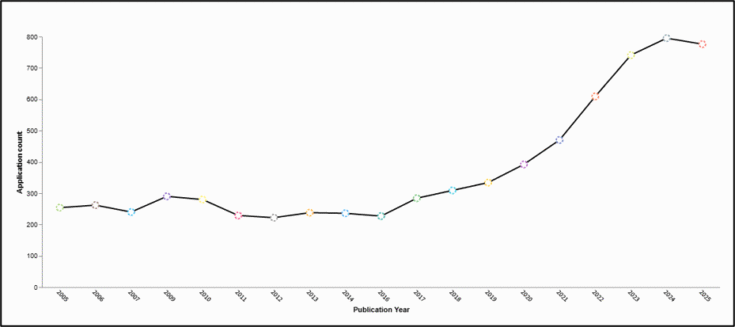
FIG. 1. Total number of patent applications published from 2005 to 2025 (by publication year) that recite adjacent word combinations of “psychoactive,” “psychotherapy” and “psycho* therapeutic” in the title, abstract, or claims. Source: Clarivate™ Derwent Patent Search. The increase in patent activity has been accompanied by increased licensing and acquisition activity. Several significant transactions announced or completed during the past year involve clinical-stage assets, platform intellectual property, or territorial commercialization rights. These transactions illustrate several emerging deal structures in the field, including outright acquisitions of individual drug candidates, acquisitions of clinical-stage companies, and territory-specific licenses that preserve the licensor’s rights outside the licensed market.
July 2026
On July 20, 2026, PharmaAla Biotech announced that it executed a definitive license agreement with Jupiter Neurosciences with exclusive U.S. rights to ALA-002. ALA-002 is PharmAla’s lead drug candidate and a patented, non-racemic MDMA formulation that is currently in U.S. clinical trials for individuals with PTSD and anxiety. The deal between PharmaAla Biotech and Jupiter includes an exclusive, perpetual license to develop, manufacture, and commercialize ALA-002 in the U.S. for an upfront payment of $3,333,333. It also includes the potential for up to $23,333,333 in development and regulatory milestones and up to $73,333,333 in commercialization milestones. PharmAla retained all rights to the candidate outside the United States.
On July 16, 2026, Eli Lilly announced that it is acquiring AtaiBeckley. 5-MeO-DMT, or BPL-003, is AtaiBeckley’s lead candidate and is entering Phase 3 clinical trials. Eli Lilly will acquire all outstanding shares of AtaiBeckley up to $3.8 billion to gain access to BPL-003 and a DMT-based candidate (VLS-01). BPL-003 is the lead asset among multiple clinical-stage programs and a discovery pipeline of next-generation compounds. With the acquisition of AtaiBeckley, “Lilly’s expertise and reach are expected to accelerate [demonstrating that psychiatric illness is treatable at its biological root] for people whose conditions have not responded to existing treatments.”3 The transaction represents one of the largest acquisitions in the psychedelic therapeutics sector to date and reflects growing confidence that next-generation neuropsychiatric therapies are approaching commercial maturity. By combining AtaiBeckley’s clinical-stage pipeline with Lilly’s global development, regulatory, manufacturing, and commercialization capabilities, the acquisition has the potential to advance the development and availability of novel treatments for patients with significant unmet medical needs.
June 2026
On June 12, 2026, Otsuka announced that it completed the acquisition of Transcend Therapeutics. Transcend was developing a methylone, or TSND-201, which is entering Phase 3 clinical trials as a PTSD candidate. The agreement resulted in a $700 million payment from Otsuka to Transcend shareholders at closing and the potential for $525 million in additional contingent considerations. In addition to the Phase 3 clinical trials for TSND-201 for PTSD, Transcend was also developing candidates for generalized anxiety disorder and major depressive disorder. Otsuka previously acquired psychedelic drug discovery company Mindset Pharma to gain control over MSP-2020 and other drug candidates.
May 2026
On May 13, 2026, PharmAla Biotech entered into an agreement with Aluvaris and Diteba to establish Restora Neurosciences, a jointly owned special-purpose vehicle formed to advance APA-01 through clinical and regulatory development. APA-01, or (R)-2-[(2H-1,3-benzodioxol-5-yl)methyl]pyrrolidine, is a novel molecule covered by U.S. Patent No. 12,042,478 and a related global patent estate. APA-01 is being developed for therapeutic applications in psychological trauma and neurological conditions, including Post-Stroke Neurorehabilitation and Traumatic Brain Injury (“TBI”). Restora’s initial objective is to complete the work required to submit a first investigational new drug application to the FDA.
The transaction is notable because PharmAla retained ownership of the underlying intellectual property while licensing development and commercialization rights to the jointly owned vehicle. PharmAla also retained an economic interest through its equity ownership, license fees, royalties, and participation in sublicensing revenue, while Aluvaris assumed responsibility for raising the capital required to fund Restora’s operations and Diteba provided development services.
October 2025
On October 17, 2025, AbbVie acquired Gilgamesh Pharmaceuticals’ lead candidate, bretisilocin, or GM-2505, for major depressive disorder at a value of $1.2 billion with $900 million paid up front.
June 2025
On June 3, 2025, Rose Hill Life Sciences announced an exclusive license from Johns Hopkins University covering intellectual property directed to the use of psychedelic therapy to improve motor function following neurological injury. The licensed technology includes psilocybin and methods for improving motor function in patients with acute, subacute, or chronic central nervous system injuries and for treating focal diaschisis associated with such injuries.
Conclusion
While social, clinical and commercial skepticism around psychedelic therapeutics remains, FDA’s final guidance establishes a more developed regulatory framework for generating reliable safety and efficacy evidence, and the ever-expanding Phase 2 and Phase 3 pipeline is generating a critical mass of assets around which pharmaceutical companies can structure licenses and acquisitions. Recent high-value transactions involving ALA-002, BPL-003, VLS-01, TSND-201, and bretisilocin demonstrate that commercial interest is extending across multiple compound classes and development stages.
Success will nevertheless depend on more than showing a pharmacological effect. Sponsors will need to address functional unblinding, durability of response, repeat dosing, safety monitoring, abuse potential, and the role of accompanying psychotherapy, while also assembling IP portfolios and commercial arrangements capable of protecting substantial development investments. As additional candidates advance toward pivotal trials and potential approval, regulatory execution and IP strategy are therefore likely to become increasingly important differentiators among psychedelic drug-development programs.
Disclaimer: The information contained in this posting does not, and is not intended to, constitute legal advice or express any opinion to be relied up legally, for investment purposes or otherwise. If you would like to obtain legal advice relating to the subject matter addressed in this posting, please consult with us or your attorney. The information in this post is also based upon publicly available information, presents opinions, and does not represent in any way whatsoever the opinions or official positions of the entities or individuals referenced herein.
- Psychedelic Drugs: Considerations for Clinical Investigations, Guidance for Industry. HHS. FDA. CDER. July 2026. Accessed July 15, 2026. https://www.fda.gov/media/169694/download. ↩︎
- Psychedelic Drugs: Considerations for Clinical Investigations. FDA. July 2026. Accessed July 15, 2026. https://www.fda.gov/regulatory-information/search-fda-guidance-documents/psychedelic-drugs-considerations-clinical-investigations. ↩︎
- Quoting AtaiBeckley’s co-founder and chief executive officer https://investor.lilly.com/news-releases/news-release-details/lilly-acquire-ataibeckley-advance-therapies-treatment-resistant ↩︎
-
On June 16, 2026, U.S. District Judge Gregory B. Williams of the United States District Court for the District of Delaware issued a memorandum order resolving three partial motions to dismiss counterclaims and strike affirmative defenses in GlaxoSmithKline Biologicals SA’s and GlaxoSmithKline LLC’s (“GSK”) mRNA patent infringement litigation against Moderna, Inc. entities (“Moderna”) and Pfizer Inc., BioNTech entities (collectively “PBNT”).
Background
GSK filed separate suits against Moderna (Civil Action Nos. 24-1135 and 1136 each filed on October 12, 2024) and PBNT (Civil Action No. 24-512 filed on April 25, 2024) alleging infringement of multiple U.S. patents relating to mRNA and lipid nanoparticle (LNP) technology. The case schedules of the Moderna and PBNT cases were consolidated on March 18, 2025, for judicial economy.
The asserted patents are: U.S. Patent Nos. 11,324,770 (filed Jan 13, 2020); 11,690,861 (filed December 13, 2022); 11,690,864 (filed December 13, 2022); and 11,717,529 (filed December 13, 2022); each a continuation application claiming priority to Provisional Patent Application No. 61/361,789 filed on July 6, 2010, and 11,786,467 (filed December 22, 2021); and 11,883,534 each a continuation application claiming priority to Provisional App. No. 61/361,830 also filed on July 6, 2010 (collectively the “Asserted Patents”).
The accused products are (1) the Moderna Spikevax® and mRESVIA® mRNA vaccine products for COVID-19 and respiratory syncytial virus (RSV), respectively, and (2) the PBNT Comirnaty® products for COVID-19 (collectively “Accused Products”).
Moderna and PBNT each responded with counterclaims and affirmative defenses including for prosecution laches and GSK moved to dismiss those counterclaims under Rule 12(b)(6) and affirmative defenses under Rule 12(f).
Laches
Nearly all of the applications that led to issuance of the asserted patents were filed after features of the Accused Products were publicly known and about 10 years from the earliest provisional and original non-provisional filing dates.
While this is accepted practice when prosecuting patents before the United States Patent and Trademark Office (“USPTO”), the Federal Circuit has held that the doctrine of prosecution laches may render a patent unenforceable when the patentee causes unreasonable and unexplained delay in prosecution that constitutes an egregious misuse of the statutory patent system under the totality of the circumstances. Cancer Rsch. Tech Ltd. v. Barr Lab’ys Inc., 635 F.3d 724, 728 (Fed. Cir. 2010).
At the pleading stage, a defendant must allege: (1) that the patentee’s delay was unreasonable and inexcusable under the totality of the circumstances, and (2) that the accused infringer suffered prejudice attributable to the delay. Personalized Media Commc’ns, LLC v. Apple Inc., 57 F.4th 1346, 1354 (Fed. Cir. 2023). There are no bright-line rules; courts evaluate the totality of circumstances as a matter of equity.
Ruling
The Court found that both Moderna and PBNT sufficiently alleged unreasonable and inexcusable delay. Key factual allegations included: prosecution histories spanning nine to twelve years from the priority applications; multiple requests for continued examination; and — importantly — allegations that GSK began pursuing claims of broader scope directed at mRNA and LNP technology only after information about defendants’ COVID-19 vaccine compositions entered the public domain. The Court reasoned that, after accepting all pleaded facts as true, these allegations support the reasonable inference that GSK’s prolonged prosecution was used not merely to obtain allowance of the originally claimed invention, but to adjust claim scope in response to intervening competitor disclosures — which raises relevant concerns that prosecution laches is designed to address.
To establish prejudice, an accused infringer must allege intervening rights — i.e., that it or others invested in, worked on, or used the claimed technology during the period of delay, and that it would have acted differently had the patentee prosecuted in a timely manner. Cancer Rsch. Tech Ltd., 625 F.3d at 729-731. Both Moderna and PBNT alleged they invested substantial time and resources developing mRNA and LNP technologies during the period of GSK’s alleged delay, only to face claims of broader scope that were enlarged after those investments were made. The Court found these allegations sufficient at the pleading stage, distinguishing the Federal Circuit’s post-trial decision in Google LLC v. Sonos, Inc. (Sonos II), 2025 WL 2473258 (Fed. Cir. Aug. 28, 2025), which held that a defendant could not “be prejudiced by incorporating into its products a feature that was publicly disclosed” in the specification of a predecessor application of the asserted patents “prior to the defendant’s investment”, on the grounds that Sonos II was decided on a fully developed evidentiary record.
The Court also addressed the specific questions of (1) whether prosecution laches applies to post-General Agreement on Trade and Tariffs (“GATT”) patents and if so (2) whether the presumption for prosecution laches is applicable in this case.
GSK argued that prosecution laches does not apply to patents issued under the post-General
Agreement on Trade and Tariffs (“GATT”) patent term framework (i.e., patents with terms measured from the application filing date rather than the grant date), contending the doctrine developed specifically to address so-called “submarine patents” under the old system. The Court rejected this argument, relying on Mojo Mobility, Inc. v. Samsung Elecs. Co., 2024 WL 3354705 (E.D. Tex. June 11, 2024), and the Federal Circuit’s decision in Personalized Media Communications, which declined to limit prosecution laches to a specific fact pattern and instead focused on whether prosecution was conducted in an equitable manner.
The Federal Circuit held in Hyatt v. Hirshfeld, 998 F.3d 1347 (Fed. Cir. 2021), that in the context of a § 145 civil action against the USPTO, an unreasonable prosecution delay of six or more years raises a presumption of prejudice, including intervening rights. Both Moderna and PBNT sought to invoke this presumption. The Court declined to extend the presumption beyond the § 145 context, finding that Hyatt expressly limits it to that setting. Accordingly, the defendants were required to affirmatively plead prejudice without the benefit of any presumption.
Conclusions
The Court emphasized that prosecution laches is an inherently fact-intensive inquiry turning on the totality of the circumstances. The surviving prosecution laches counterclaims and affirmative defenses will proceed to discovery. Whether the evidence ultimately supports a finding of prosecution laches — and thus unenforceability of the asserted patents — remains to be determined at summary judgment or trial on a fully developed factual record.
How this laches issue plays out in in this case will be interesting to follow, especially for parties that seek to enforce and defend against such later-filed patent applications based on old portfolios that are still active.
-

Targeted protein degradation (TPD) has moved from promising concept to near-commercial reality in under a decade. By hijacking the cell’s ubiquitin-proteasome system, TPD therapies eliminate disease-driving proteins entirely rather than merely inhibiting them. This approach is particularly powerful against “undruggable” targets that lack deep binding pockets. PROTACs (proteolysis-targeting chimeras) and molecular glues remain the most clinically advanced modalities, but LYTACs (lysosome-targeting chimeras), AUTACs (autophagy-targeting chimeras), DUBTACs (deubiquitinase-targeting chimeras), and degrader-antibody conjugates (DACs) are advancing rapidly.
Parallel to the scientific maturation, patent filings, including those covering E3 ligase binders, bifunctional scaffolds, linkers, and mechanisms of degradation, have expanded significantly, creating a layered and increasingly competitive patent environment.
We previously examined targeted protein degradation (TPD) as an emerging frontier in precision medicine. Since then, the field has materially accelerated as large-pharma collaborations have expanded in scale, late-stage assets shift commercialization strategies, and M&A activity reflects that protein degraders are now core pipeline priorities.
Here we provide updates on patent activity, recent transactions, clinical developments across PROTACs and molecular glues, and evolving partnership and IP considerations shaping the TPD landscape in early 2026.
Patent Landscape: From Foundational Platform IP to Dense Thickets
The IP landscape surrounding targeted protein degradation has evolved as rapidly as the science. Early patent activity in the field focused on foundational platform IP, including bifunctional molecule scaffolds, E3 ligase recruiting ligands (e.g., cereblon, VHL, IAP), linker chemistry, and general methods of inducing ubiquitination and proteasomal degradation. Those early filings now form the backbone of a dense and increasingly overlapping patent landscape.
As clinical assets advance, the focus for IP filers has shifted toward layered protection strategies including:
- Composition-of-matter claims directed to specific degrader molecules and defined linkers.
- Genus claims covering structurally-related degraders targeting the same protein.
- Target-specific degradation methods tied to defined E3 ligases.
- Formulation, dosing, and combination therapy claims designed to extend lifecycle protection.
- Platform claims directed to screening technologies, proteomics approaches, and induced-proximity mechanisms.
Patent filings in the TPD space have grown steadily over the past decade, with published U.S. and PCT applications increasing materially year-over-year between 2020 and 2025, with no signs of slowing in early 2026.[1] In fact, there are already more application publications in the first quarter of 2026 than the total number of publications in 2020.[2] Landscape analyses have identified hundreds of patent families directed to PROTACs and bifunctional degraders alone, underscoring the breadth of active assignees and the competitive intensity of this area.
As a snapshot, the assignees with the most published patent families in the TPD space since 2024 are shown below:[3]
Rank Optimized Assignee # of Patent Families 1 ROCHE HOLDING LTD. 14 2 CHINESE ACADEMY OF SCIENCE 13 3 C4 THERAPEUTICS INC 11 4 YALE UNIVERSITY 11 5 UNIVERSITY OF CALIFORNIA 10 6 INSTITUT NATIONAL DE LA SANTE ET DE LA RECHERCHE MEDICALE 9 7 MONTE ROSA THERAPEUTICS AG 9 8 DANA-FARBER CANCER INSTITUTE (INC.) 8 9 HANGZHOU ZHONGMEI HUADONG PHARM CO LTD 8 10 MERCK & CO. INC. 8 For molecular glues, the IP analysis presents distinct challenges. Many next-generation cereblon modulators must be differentiated from legacy immunomodulatory imide drug (IMiD) estates, which can require careful claim drafting. Functional claiming tied to induced proximity also raises enablement and written description considerations, as courts increasingly scrutinize broad genus claims, even in the small-molecule context.
The result is a patent environment that is no longer driven mainly by invention, but also by freedom-to-operate concerns. To succeed, companies must evaluate:
- The breadth and enforceability of early foundational patent families;
- Competing linker and scaffold coverage;
- Target-specific degradation claims filed by early movers;
- Potential post-grant challenges to broad foundational filings, particularly broad functionally-claimed molecules; and
- Jurisdiction-specific differences in claim interpretation and exclusivities.
Accordingly, IP strategy in TPD has shifted from offensive filing to proactive portfolio management, e.g., by integrating offensive and defensive prosecution strategies, transaction structuring including licensing and acquisitions, proactive patent challenges, and litigation readiness into core development planning.
New PROTACs and Molecular Glues in Development
In the last year, new PROTACs and molecular glues have entered development and there have been several updates to those already in development.
PROTACs
As for new PROTACs in development, Amgen acquired Dark Blue Therapeutics Ltd., adding the MLLT1/3 degrader to Amgen’s portfolio. According to Jay Bradner, M.D., executive vice president of Research and Development at Amgen, “[t]his acquisition complements and extends our research in targeted protein degradation and leukemia therapeutics, advancing our strategy to invest early in rising medicines for novel therapeutic targets. The adjacency of this program to our considered expertise in cancer biology will propel MLLT1/3-targeting medicines to clinical investigation for patients facing the challenging diagnosis of AML.”[4]
Beyond pipeline expansion, acquisitions of first-in-class degraders may secure control over composition-of-matter claims and target-specific degradation patent estates, which can define exclusivity boundaries for follow-on entrants targeting the same protein.
While many of the clinical trials are still active and ongoing, others are now complete. An updated version of PROTACs in development are listed below:
Name Company Description Clinical Trials ARV-471 Vepdegestrant[5] Arvinas & Pfizer An estrogen receptor (ER) degrader for hormone-receptor-positive breast cancer Phase III trials (NCT05654623) – active[6] ARV-110 Bavdegalutamide[7] Arvinas An androgen receptor (AR) degrader for prostate cancer Phase II trials (NCT03888612) – completed[8] ARV-766[9] Arvinas An androgen receptor (AR) degrader treating metastatic castration-resistant prostate cancer Phase II trials (NCT05067140) – active[10] NX-2127[11] Nurix A BTK degrader for B-cell malignancies Phase I trials (NCT04830137) – recruiting[12] KT-333[13] Kymera Selective degradation of the transcriptional regulator signal transducer and activator of transcription 3 (STAT3) for treating peripheral T-cell lymphoma, cutaneous T-cell lymphoma, large granular lymphocytic leukemia, and solid tumors Phase I trials (NCT05225584) – completed[14] HSK29116[15] Haisco Pharmaceutical Bruton tyrosine kinase-targeting for treating relapsed or refractory B-cell malignancies Phase I trials (NCT04861779) – status unknown[16] MLLT 1/3 Degrader[17] Amgen (via Dark Blue Therapeutics) First-in-class small molecule degrader of the transcriptional regulator, MLLT 1/3, for use as monotherapy and as backbone in combination therapy in patients with AML, solid cancers IND enabling studies BMS-986365 Celgene (acquired by Bristol Myers Squibb) Compare efficacy and safety of BMS-986365 compared to investigator’s choice of therapy for treating metastatic castration-resistant prostate cancer Phase III trials (NCT06764485) – recruiting[18] BGB-16673 BeOne Medicines (formerly BeiGene) Recommended dosing exploration for BGB-16673. Phase I and II trials (NCT05006716) – recruiting[19] DT2216 Dana-Farber Cancer Institute & U.S. Department of Defense & Dialectic Therapeutics & American Society of Clinical Oncology DT2216 and Paclitaxel in treating platinum-resistant ovarian cancer Phase I trials (NCT06964009) – recruiting[20] Molecular Glues
The majority of clinical trials for molecular glues remain active. In addition, SEED Therapeutics has entered clinical trials with its molecular glue and announced, “the dosing of the first patient in its Phase 1a dose-escalation study of ST-01156, an oral RMB39 degrader, in patients with advanced solid tumors.”[21]
As next-generation molecular glues advance, patent strategy increasingly turns on differentiation from legacy patent estates, such as those directed to cereblon-modulation. Structural changes, altered substrate specificity, or new mechanistic distinctions are central both to patentability and freedom-to-operate analyses.
An updated table of examples of molecular glues that are FDA-approved or in development is shown below:
Name Company Description Clinical Trials CC-90009[22] Bristol Myers Squibb A cereblon-binding molecular glue targeting GSPT1, in clinical trials for acute myeloid leukemia (AML) Phase I trial terminated due to lack of efficacy in the short-term acute phase (NCT02848001) dBET1[23] Dana-Farber Cancer Institute & C4 Therapeutics A BRD4 degrader that recruits cereblon to induce degradation Preclinical Lenalidomide (Revlimid)[24] Bristol Myers Squibb Originally developed as an immunomodulator, later shown to function as a molecular glue that induces degradation of IKZF1 and IKZF3, transcription factors critical in multiple myeloma FDA approved Thalidomide[25] Bristol Myers Squibb The first immunomodulatory drug (IMiD) shown to induce degradation of IKZF1 and IKZF3 via cereblon; used in multiple myeloma and erythema nodosum leprosum FDA approved Pomalidomide (Pomalyst)[26] Bristol Myers Squibb Another IMiD acting as a molecular glue targeting IKZF1 and IKZF3 in multiple myeloma FDA approved CC-122[27] Bristol Myers Squibb A next-generation cereblon modulator targeting IKZF1, IKZF3, and ZFP91; in clinical trials for lymphoma and solid tumors. Phase I trial completed (NCT01421524) for patients with advanced solid Tumors, non-Hodgkin’s Lymphoma, or Multiple Myeloma Iberdomide (CC-220)[28] Bristol Myers Squibb/Celgene Targets IKZF1, IKZF3, ZFP91, and ZNF98; in trials for relapsed/refractory multiple myeloma and systemic lupus erythematosus. Phase II trial targeting IKZF1/3 for treatment of RRMM (NCT04975997) – active[29] CC-99282[30] Bristol Myers Squibb A cereblon modulator targeting IKZF1 and IKZF3 In development for B-cell lymphomas (NCT03930953) – active[31] CC-92480[32] Bristol Myers Squibb IKZF1/3 degrader In trials for multiple myeloma and non-Hodgkin lymphoma (NHL) (NCT03989414) – active[33] DKY-709[34] Novartis Targets IKZF2 Phase I trials for solid tumors, alone or in combination with checkpoint inhibitors (NCT03891953) – active[35] ST-01156 SEED Therapeutics Orally administered, brain-penetrant molecular glue degrader designed to selectively degrade RBM39, a key regulator of RNA splicing and transcription required for the survival of several cancer types Phase I trials (NCT07197554) Key Players in the Targeted Protein Degradation Landscape
Biotechnology and pharmaceutical companies continue to actively pursue TPD therapies. Companies with notable programs in the TPD field are provided in the updated table below.
Company Key Focus Notable Programs Collaborations Arvinas PROTACs ARV-471 (ER degrader), ARV-110 (AR degrader) Novartis[36] Pfizer[37] Foghorn Therapeutics PROTACs (BRD9 Degraders) FHD-609[38], FHD-909 Eli Lilly Monte Rosa Therapeutics Molecular glues MRT-6160 (T and B cell-modulating VAV1-directed molecular glue degraders) Novartis[39] Nurix Therapeutics E3 ligase modulation, PROTACs GS-6791 (previously NX-0479; IRAK4 degrader) NX-2127 (BTK degrader) NX-5948 (BTK degrader) STAT6 signal transducer and activator of transcription Gilead[40] Sanofi[41] Seagen[42] Kymera Therapeutics PROTACs KT-474 (IRAK4 degrader) Sanofi[43] Vertex[44] C4 Therapeutics PROTACs BiDAC platform CFT7455 (IKZF1/3 degrader) Utilize TORPEDO platform to discover degraders Biogen[45] Merck[46] Betta Pharma[47] Bristol Myers Squibb (BMS) Molecular glues CC-90009, Revlimid Celgene IP estate[48] Novartis Molecular glues, PROTACs Targeting undrugged proteins Dunad Therapeutics[49] Pfizer, Merck, Roche Various TPD strategies Internal discovery programs External licensing SEED Therapeutics Molecular glues, Tau degrader ST-01156 Eli Lilly, Eisai[50] EpiBiologics Combination therapies including bispecific antibodies with degraders EpiTAC; undisclosed discovery programs Johnson & Johnson, Google Ventures[51] Amgen PROTACs, molecular glues Acquisition of Dark Blue Therapeutics Ltd. M&A[52] Licensing
As we outlined in our prior post on TPD, because TPD is an innovative therapeutic approach, numerous strategic partnerships and licensing agreements are aimed at advancing TPD technologies. Below we discuss (a) updates to existing deals and collaborations, (b) new licensing deals and collaborations, (c) upcoming milestones in existing collaborations, and (d) licensing deals and collaborations with no significant updates. Many of these agreements reflect not just scientific collaboration, but access to platform intellectual property, field-of-use exclusivity, and risk allocation tied to patent term and portfolio strength.
Updates to Existing Deals and Collaborations
In September 2025, Arvinas and Pfizer provided an update on their collaboration for the development of vepdegestrant, an oral PROTAC estrogen receptor protein degrader. Specifically, the collaborators agreed to out-license the vepdegestrant commercialization rights to a third party. Arvinas and Pfizer seek a party “with the capabilities and expertise to maximize the commercial potential of vepdegestrant, if approved, for patients with ESR1-mutant, ER+/HER2-advanced or metastatic breast cancer and potentially develop vepdegestrant in new settings.”[53]
Also in September 2025, Monte Rosa and Novartis announced their collaboration on a second deal for accelerating the development of molecular glue degrader for immune-mediated diseases.[54]
Parties IP/Asset Focus Description of Licensing Deal Arvinas and Pfizer[55] ARV-471 (AR degrader) Vepdegestrant In September 2025, Arvinas and Pfizer agreed to out-license the commercialization rights to vepdegestrant to a third party.[56] The Arvinas investigational PROTAC degraders currently in Phase 1 trials are: ARV-102 (LRRK2 degrader), ARV-393 (BCL6 degrader), and ARV-806 (KRAS G12D degrader). In August 2025, the FDA accepted the New Drug Application (NDA) for ARV-47, or vepdegestrant. The NDA submission was based on a Phase 3 trial.[57] In 2021, Arvinas partnered with Pfizer to develop and commercialize ARV-471, an oral estrogen receptor protein degrader for breast cancer. Arvinas received an upfront payment and is eligible for up to $1.4 billion in milestones, sharing profits and costs equally. Monte Rosa Therapeutics and Novartis[58] MRT-6160 and other VAV1 molecular glue degraders In September 2025, Monte Rosa and Novartis entered a second deal focused on accelerating development of molecular glue degrader for immune-mediated diseases. In October 2024, Novartis agreed to pay Monte Rosa Therapeutics $150 million upfront for a global license to develop molecular glue degraders, with potential future payments up to $2.1 billion and royalties on non-U.S. sales. New Licensing Deals
A few new deals have recently been announced. In June 2025, Gilead Sciences and Kymera Therapeutics entered into an exclusive option and license agreement for the development and acceleration of a novel molecular glue degrader targeting cyclin-dependent kinase 2 (CDK2) with the potential for broad oncology treatment including in breast cancer and other solid tumors.[59]
Although not a formal licensing deal, the UK’s Institute of Cancer Research (ICR) Centre for Protein Degradation and NEOsphere Biotechnologies announced a research collaboration on October 2, 2025, aimed at accelerating molecular glue degrader discovery.[60]
Parties IP/Asset Focus Description of Licensing Deal or Collaboration Kymera Therapeutics and Gilead Sciences[61] Cyclin-dependent kinase 2 (CDK2)-directed molecular glue degraders (MGD) In June 2025, Kymera and Gilead entered into an exclusive option and license agreement to accelerate the development of the novel CDK2-directed MGDs. Kymera will lead the research activities for the program and Gilead has the right to exercise an option to exclusively license the program. Kymera is eligible to receive up to $750 million in payments, including several million dollars for upfront and potential option exercise payments. Institute of Cancer Research (ICR) Centre for Protein Degradation and NEOsphere Biotechnologies[62] Molecular glues Using high-throughput proteomics to rapidly assess proteome-wide effects of compound modifications, enabling faster iteration and more efficient refinement of promising molecular glue degrader drug candidates. Upcoming Milestones in Existing Licensing Deals
The C4 Therapeutics and Betta Pharmaceuticals deal has not yet had significant updates, but CFT8919, the EGFR degrader for non-small-cell lung cancer, is set to use data from the Phase 1 trial to inform potential ex-China clinical development by the end of Q1 2026.[63]
Parties IP/Asset Focus Description of Licensing Deal C4 Therapeutics and Betta Pharmaceuticals[64] CFT8919 (EGFR degrader, China) End of Q1 2026: Data from Phase 1 trial will be used to inform potential ex-China clinical development. In May 2023, C4 Therapeutics partnered with Betta Pharmaceuticals for the development and commercialization of CFT8919 in Greater China. The deal involved a $10 million upfront payment, a $25 million equity investment, and up to $357 million in potential milestones, plus royalties. No Significant Updates to Licensing Deals and Collaborations
Deals involving (a) Nurix Therapeutics and Sanofi, (b) Arvinas and Novartis, (c) Kymera and Vertex, (d) Vividion and Roche, (e) C4 Therapeutics and Merck, (f) Gilead and Nurix, and (g) Seagen (now Pfizer) and Nurix have not announced significant updates, but there is no indication that the deals have ceased.
Parties IP/Asset Focus Description of Licensing Deal Nurix Therapeutics and Sanofi[65] E3 ligase modulators In April 2025, Nurix extended its collaboration with Sanofi, focusing on a novel transcription factor for autoimmune diseases. Nurix received a $15 million extension fee, bringing the total received to $105 million, with potential for up to $465 million in future milestones per licensed program, plus royalties. Arvinas and Novartis[66] ARV-766 (AR degrader) In April 2024, Arvinas licensed its Phase 3-ready protein degrader, ARV-766, to Novartis for an upfront payment of $150 million. The agreement includes potential milestones up to $1.01 billion and tiered royalties. Kymera Therapeutics and Vertex Pharmaceuticals[67] Undisclosed degrader targets In 2019, Kymera entered a four-year collaboration with Vertex, receiving $70 million upfront, including an equity investment. The partnership aims to develop protein degradation drugs for serious diseases, with potential deal value exceeding $1 billion. Vividion Therapeutics and Roche[68] E3 ligases and select oncology targets In May 2020, Vividion inked a deal with Roche, receiving $135 million upfront to utilize its proteomics screening platform for discovering novel E3 ligases, with potential for several billion dollars in milestone payments and royalties. C4 Therapeutics and Merck KGaA[69] Targeted protein degraders under C4 TORPEDO platform In March 2024, C4 Therapeutics announced a collaboration with Merck KGaA to develop targeted protein degraders for oncogenic proteins. C4T received a $16 million upfront payment, with Merck covering discovery research costs. Nurix Therapeutics and Gilead Sciences[70] IRAK4 degraders including GS-6791 Nurix and Gilead extended their collaboration in 2024 for an additional two years, focusing on developing targeted protein degraders. Gilead paid a $15 million extension fee, aiming to advance multiple degrader programs. Seagen and Nurix Therapeutics[71] Two unnamed products based on Nurix DELigase platform In September 2023, Nurix and Seagen initiated a strategic collaboration to develop Degrader-Antibody Conjugates (DACs), combining targeted protein degradation with antibody-drug conjugation to selectively kill cancer cells. Patent Term and Lifecycle Strategy
As first-generation degraders approach late-stage development, companies are increasingly focused on exclusivity duration. Follow-on degraders with modified ligase recruiters, optimized linkers, alternative binding epitopes, improved oral bioavailability, or enhanced CNS penetration may support new composition-of-matter protection and extend effective exclusivity horizons. Simultaneously, combination approaches, including degrader-antibody conjugates and multi-modal constructs, likewise create opportunities for secondary filings that augment core platform patents and extend exclusivity.
Conclusion
Targeted protein degradation (TPD) continues to redefine the boundaries of drug discovery, offering transformative solutions for previously intractable diseases. With PROTACs, molecular glues, and emerging modalities like DUBTACs and LYTACs driving clinical successes, the TPD market is on track to explode higher. Yet, this promise comes with challenges: navigating a dense patent landscape, securing freedom to operate, and overcoming scientific and regulatory hurdles require strategic precision. As the TPD field accelerates, partnering with the patent counsel with subject matter expertise is critical to staying ahead.
Disclaimer: The information contained in this posting does not, and is not intended to, constitute legal advice or express any opinion to be relied up legally, for investment purposes or otherwise. If you would like to obtain legal advice relating to the subject matter addressed in this posting, please consult with us or your attorney. The information in this post is also based upon publicly available information, presents opinions, and does not represent in any way whatsoever the opinions or official positions of the entities or individuals referenced herein.
[1] Search of Derwent database March 2026 (INPADOC family count and publication year results generated using the keyword query: (CTB=((protein ADJ degrad*) OR (PROTAC OR proteolysis ADJ target* ADJ chimera) OR “molecular glue” OR (LYTAC OR lysosome ADJ target* ADJ chimera) OR (AUTAC OR autophagy ADJ target* ADJ chimera) OR (ATTEC OR autophagy ADJ teth* ADJ compound AND (AD>=(20200101)) AND (CC=(US OR WO)).
[2] Id.
[3] Search of Derwent database March 2026 (INPADOC family count and publication year results generated using the keyword query: (CTB=((protein ADJ degrad*) OR (PROTAC OR proteolysis ADJ target* ADJ chimera) OR “molecular glue” OR (LYTAC OR lysosome ADJ target* ADJ chimera) OR (AUTAC OR autophagy ADJ target* ADJ chimera) OR (ATTEC OR autophagy ADJ teth* ADJ compound AND (AD>=(20240101)) AND (CC=(US OR WO)); sorted by Optimized Assignee.
[4] Id.
[5] Tan, Xueqiang, et al. “Molecular glue-mediated targeted protein degradation: A novel strategy in small-molecule drug development.” Iscience (2024).
[6] https://clinicaltrials.gov/study/NCT05654623?cond=NCT05654623&rank=1
[7] Tan et al.
[8] https://clinicaltrials.gov/study/NCT03888612
[9] Tan et al.
[10] https://clinicaltrials.gov/study/NCT05067140
[11] Danilov, Alexey, et al. “A first-in-Human phase 1 trial of NX-2127, a first-in-class Bruton’s Tyrosine Kinase (BTK) dual-targeted protein degrader with immunomodulatory activity, in patients with relapsed/refractory B cell malignancies.” Blood 142 (2023): 4463.
[12] https://clinicaltrials.gov/study/NCT04830137
[13] Tan et al.
[14] https://clinicaltrials.gov/study/NCT05225584
[15] Tan et al.
[16] https://clinicaltrials.gov/study/NCT04861779
[17] https://www.darkbluetx.com/our-science#pipeline
[18] https://clinicaltrials.gov/study/NCT06764485
[19] https://clinicaltrials.gov/study/NCT05006716
[20] https://clinicaltrials.gov/study/NCT06964009
[21] https://www.seedtherapeutics.com/media/seed-therapeutics-doses-first-patient-in-phase-1-trial-of-st-01156-a-molecular-glue-degrader-targeting-rbm39-2
[22] Hansen, Joshua D., et al. “CC-90009: a cereblon E3 ligase modulating drug that promotes selective degradation of GSPT1 for the treatment of acute myeloid leukemia.” Journal of medicinal chemistry 64.4 (2021): 1835-1843.
[23] Liu, Lei, et al. “Targeted BRD4 protein degradation by dBET1 ameliorates acute ischemic brain injury and improves functional outcomes associated with reduced neuroinflammation and oxidative stress and preservation of blood–brain barrier integrity.” Journal of neuroinflammation 19.1 (2022): 168.
[24] Yamanaka, Satoshi, et al. “Lenalidomide derivatives and proteolysis-targeting chimeras for controlling neosubstrate degradation.” Nature communications 14.1 (2023): 4683.
[25] Oleinikovas, Vladas, et al. “From thalidomide to rational molecular glue design for targeted protein degradation.” Annual review of pharmacology and toxicology 64.1 (2024): 291-312.
[26] Sasso, Janet M., et al. “Molecular glues: the adhesive connecting targeted protein degradation to the clinic.” Biochemistry 62.3 (2022): 601-623.
[27] Id.
[28] Id.
[29] https://clinicaltrials.gov/study/NCT04975997
[30] Sasso et al.
[31] https://clinicaltrials.gov/study/NCT03930953
[32] Hansen, Joshua D., et al. “Discovery of CRBN E3 ligase modulator CC-92480 for the treatment of relapsed and refractory multiple myeloma.” Journal of medicinal chemistry 63.13 (2020): 6648-6676.
[33] https://www.bmsclinicaltrials.com/us/en/clinical-trials/NCT03989414
[34] Hansen et al.
[35] https://clinicaltrials.gov/study/NCT03891953
[36] https://ir.arvinas.com/news-releases/news-release-details/arvinas-enters-transaction-novartis-including-global-license
[37] https://www.pfizer.com/news/press-release/press-release-detail/arvinas-and-pfizer-announce-global-collaboration-develop
[38] https://foghorntx.com/wp-content/uploads/2023/04/Netherton_DDC_2023_presentation.pdf
[39] https://ir.monterosatx.com/news-releases/news-release-details/monte-rosa-therapeutics-announces-global-license-agreement; https://ir.monterosatx.com/news-releases/news-release-details/monte-rosa-therapeutics-announces-collaboration-novartis
[40] https://ir.nurixtx.com/news-releases/news-release-details/nurix-therapeutics-outlines-2025-goals-and-objectives
[41] https://ir.nurixtx.com/news-releases/news-release-details/nurix-therapeutics-announces-extension-strategic-collaboration-0
[42] https://ir.nurixtx.com/news-releases/news-release-details/nurix-announces-strategic-collaboration-seagen-combining
[43] https://investors.kymeratx.com/news-releases/news-release-details/kymera-announces-expansion-kt-474-sar444656-hs-and-ad-phase-2
[44] https://investors.vrtx.com/news-releases/news-release-details/vertex-and-kymera-therapeutics-establish-strategic-collaboration
[45] https://ir.c4therapeutics.com/news-releases/news-release-details/c4-therapeutics-announces-delivery-second-development-candidate
[46] https://ir.c4therapeutics.com/news-releases/news-release-details/c4-therapeutics-announces-strategic-discovery-research
[47] https://ir.c4therapeutics.com/news-releases/news-release-details/c4-therapeutics-and-betta-pharmaceuticals-announce-exclusive
[48] https://news.bms.com/news/details/2019/Bristol-Myers-Squibb-to-Acquire-Celgene-to-Create-a-Premier-Innovative-Biopharma-Company/default.aspx
[49] https://www.biospace.com/novartis-strikes-1-3-billion-deal-with-protein-degradation-startup-dunad-therapeutics
[50] https://www.seedtherapeutics.com/media/seed-therapeutics-completes-30-million-series-a-3-financing; https://beyondspringpharma.com/beyondspring-subsidiary-seed-therapeutics-announces-research-collaboration-and-license-agreement-with-lilly/
[51] https://www.fiercebiotech.com/biotech/jj-gv-line-back-protein-degradation-biotech-epibiologics-107m-series-b
[52] https://www.amgen.com/newsroom/press-releases/2026/01/amgen-acquires-dark-blue-therapeutics-bolstering-oncology-pipeline.
[53] https://ir.arvinas.com/news-releases/news-release-details/arvinas-provides-update-collaboration-pfizer-and-announces
[54] https://ir.monterosatx.com/news-releases/news-release-details/monte-rosa-therapeutics-announces-collaboration-novartis
[55] https://www.pfizer.com/news/press-release/press-release-detail/arvinas-and-pfizer-announce-global-collaboration-develop
[56] https://ir.arvinas.com/news-releases/news-release-details/arvinas-provides-update-collaboration-pfizer-and-announces
[57] https://ir.arvinas.com/news-releases/news-release-details/arvinas-announces-fda-acceptance-new-drug-application
[58] https://ir.monterosatx.com/news-releases/news-release-details/monte-rosa-therapeutics-announces-closing-global-license
[59] https://investors.kymeratx.com/news-releases/news-release-details/gilead-sciences-and-kymera-therapeutics-enter-exclusive-option
[60] https://www.icr.ac.uk/about-us/icr-news/detail/icr-centre-for-protein-degradation-and-neosphere-biotechnologies-announce-research-collaboration–to-discover-new-molecular-glue-degrader-therapeutics
[61] https://investors.kymeratx.com/news-releases/news-release-details/gilead-sciences-and-kymera-therapeutics-enter-exclusive-option
[62] https://www.icr.ac.uk/about-us/icr-news/detail/icr-centre-for-protein-degradation-and-neosphere-biotechnologies-announce-research-collaboration–to-discover-new-molecular-glue-degrader-therapeutics
[63] https://www.biospace.com/press-releases/c4-therapeutics-reports-fourth-quarter-and-full-year-2025-financial-results-and-recent-business-highlights
[64] https://ir.c4therapeutics.com/news-releases/news-release-details/c4-therapeutics-and-betta-pharmaceuticals-announce-exclusive
[65] https://ir.nurixtx.com/news-releases/news-release-details/nurix-licenses-drug-discovery-program-sanofi-targeting-novel
[66] https://ir.arvinas.com/news-releases/news-release-details/arvinas-enters-transaction-novartis-including-global-license
[67] https://investors.vrtx.com/news-releases/news-release-details/vertex-and-kymera-therapeutics-establish-strategic-collaboration
[68] https://vividion.com/news/vividion-therapeutics-announces-drug-discovery-collaboration-with-roche-focused-on-novel-e3-ligases/
[69] https://ir.c4therapeutics.com/news-releases/news-release-details/c4-therapeutics-announces-strategic-discovery-research
[70] https://ir.nurixtx.com/news-releases/news-release-details/nurix-therapeutics-announces-extension-strategic-collaboration
[71] https://ir.nurixtx.com/news-releases/news-release-details/nurix-announces-strategic-collaboration-seagen-combining

Subscribe
Stay current on the legal and industry developments that impact businesses across the globe by subscribing to receive updates from Rothwell Figg.